Login
Login
Register
Complete Your Profile
Change Password
Request a Password Reset
Download Documents
Download Documents
Get Help to Participate in This Tender
Change Password
For better security, update the account password.
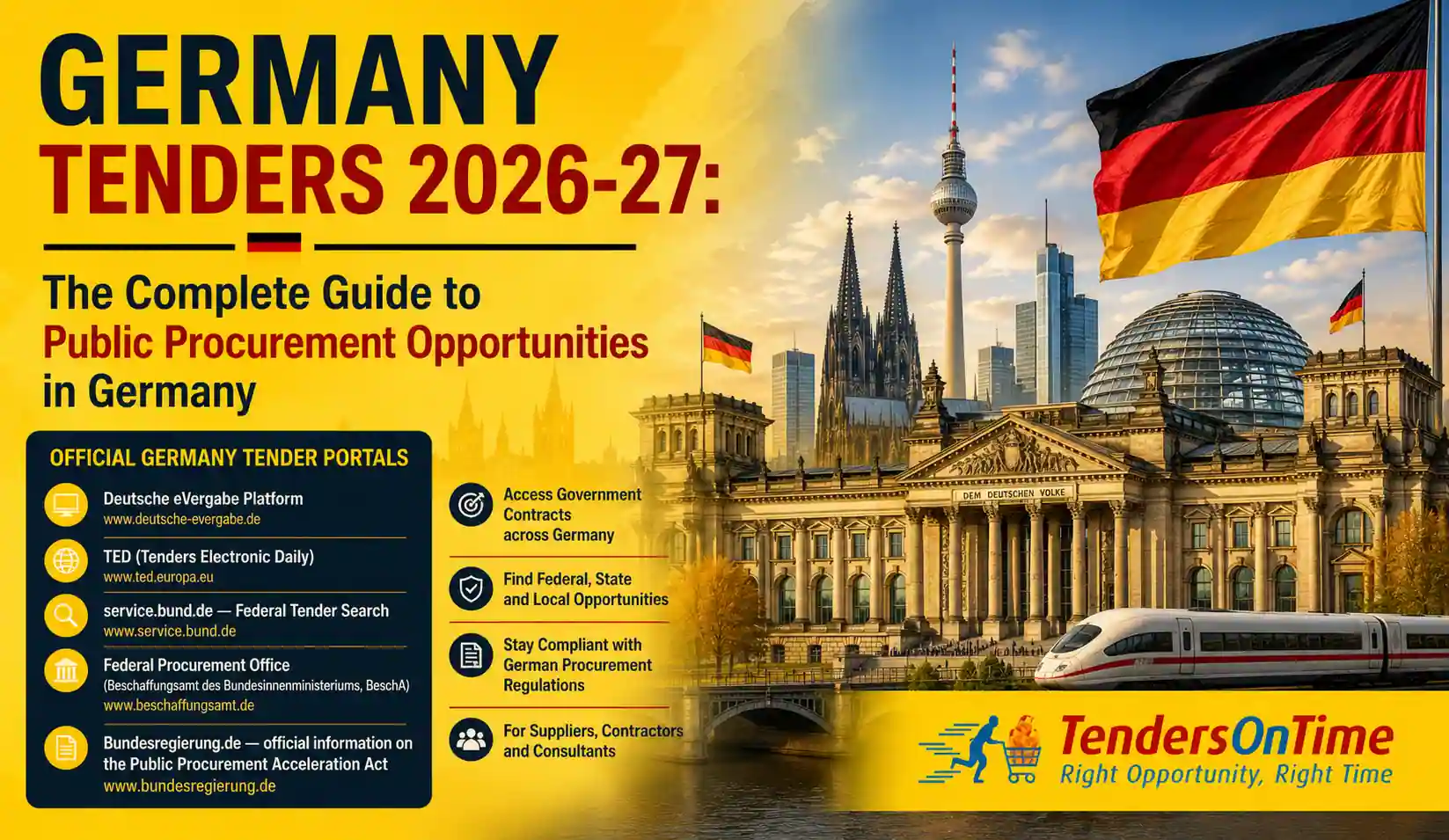
Published on TendersOnTime | Category: Canada Procurement | Reading time: 15 min
Germany runs one of the largest public procurement markets on earth. According to the operators of the German Tender Portal (Deutsches Vergabeportal, DTVP), Germany publishes an estimated 2.5 million public tenders worth a combined €360 billion every year, a market that spans everything from city-level cleaning contracts to multi billion euro frigate programmes for the federal navy.
2026-27 is not a routine year for that market. Germany's federal government adopted a record €524.5 billion federal budget for 2026-27, with total federal investment combining the core budget with the Special Fund for Infrastructure and Climate Neutrality (Sondervermögen Infrastruktur und Klimaneutralität) and the Climate and Transformation Fund expected to reach roughly €126.7 billion, a second consecutive record. Defence spending alone is rising to approximately €82.7 billion in the core budget, with total defence related commitments closer to €108 billion once special-fund contributions are included. At the same time, the German government is preparing to bring into force the most significant reform of national procurement law in almost a decade: the Public Procurement Acceleration Act (Vergabebeschleunigungsgesetz), effective 1 July 2026.
Several forces are converging at once to drive this surge of activity:
This guide is written for the full range of businesses that stand to benefit from this activity: local German suppliers and contractors, EU-based companies looking to expand into the German market, international firms from outside the EU exploring German opportunities, SMEs and young companies seeking their first government contracts, procurement professionals and consultants advising clients on German bids and contracting authorities who want a clear reference on how the rules are changing. By the end of this guide, you will understand the legal framework governing German tenders, exactly how to register and bid through the relevant portals, what the 2026-27 reform changes in practice and how to avoid the most common and costly mistakes foreign and first-time bidders make.
→ Explore live German tenders now on TendersOnTime's Germany Tenders page
German public procurement law is layered: a set of overarching principles sits above EU thresholds, while a parallel, more flexible set of national rules governs everything below them. Both layers ultimately implement the EU's public procurement directives into German practice, but the procedures, evidence requirements and review rights differ significantly depending on which layer applies to your tender.
The Act Against Restraints of Competition (GWB)
The Gesetz gegen Wettbewerbsbeschränkungen (GWB), the Act Against Restraints of Competition is the primary legislation governing public procurement in Germany above EU thresholds. Part 4 of the GWB sets out the fundamental procedural and competition principles that apply to every above-threshold public contract, split into a chapter on award procedures (eligibility, procedure types, contract award, modification and concessions) and a chapter on the review process before the procurement chambers (Vergabekammern) and the higher regional courts (Oberlandesgerichte).
Section 97 GWB sets out the core principles that govern the entire system:
The Public Procurement Regulation (VgV)
The Vergabeverordnung (VgV) implements EU Directive 2014/24/EU and fleshes out Sections 97 et seq. of the GWB into detailed procedural rules. It applies to public supply and service contracts above the EU thresholds awarded by "classic" public contracting authorities (federal, state and municipal bodies, public law institutions and certain publicly controlled entities). The VgV governs which procedure type applies, the minimum deadlines for each stage, how suitability is assessed, how award criteria are weighted and the mandatory use of electronic procurement.
Other Key Procurement Regulations
Beyond the GWB and VgV, several sector-specific ordinances apply depending on what is being procured:
Importantly, federal and state governments are also working toward a more unified set of sub-threshold rules: in a December 2025 paper titled the "Federal Modernisation Agenda" (Föderale Modernisierungsagenda), the federal government and the states (Länder) agreed to revise the UVgO and the first section of VOB/A by the end of 2026, aiming to harmonise the value thresholds and reduce the administrative burden of navigating sixteen different state-level sub-threshold regimes.
The single biggest change to German procurement law in 2026 is the Public Procurement Acceleration Act (Gesetz zur Beschleunigung der Vergabe öffentlicher Aufträge). The Bundestag passed the law on 23 April 2026, the Bundesrat approved it on 8 May 2026 and it was published in the Bundesgesetzblatt (Federal Law Gazette) on 18 May 2026. It takes effect on 1 July 2026 and amends the GWB, the VgV and the SektVO.
The reform does not replace Germany's procurement system; it makes targeted adjustments designed to cut bureaucracy, speed up large infrastructure and digitalisation projects and open the market further to SMEs, start-ups and young companies all within the boundaries set by EU procurement directives, which Germany cannot unilaterally exceed.
Key changes taking effect on 1 July 2026 include:
The government estimates the reform will save public administrations and the wider economy nearly €380 million annually in reduced compliance and procedural overhead. Independent legal commentary is more cautious: several firms describe the Act as a meaningful but incremental step "Beschleunigung in Grenzen" (acceleration within limits) rather than a wholesale restructuring, since Germany's procurement law remains firmly anchored in EU directives that the national legislature cannot override.
For more background on the broader move toward digital procurement that this Act builds on, see TendersOnTime's overview of what e-procurement is and how it works.
Whether your tender is governed by EU-wide rules or German national rules depends entirely on its estimated net contract value. Get this wrong and you risk preparing a bid under the wrong set of evidence and procedural requirements.
EU Thresholds
The European Commission revises EU procurement thresholds every two years to reflect currency movements and international trade commitments under the WTO Government Procurement Agreement. The thresholds applicable from 1 January 2026 through the end of 2027 set out in Commission Delegated Regulations (EU) 2025/2150, 2025/2151 and 2025/2152 were revised downward compared to the 2024–2025 period:
| Category | Threshold from 1 January 2026 (excl. VAT) | Previous threshold (2024–2025) |
|---|---|---|
| Supplies and services central government authorities | €140,000 | €143,000 |
| Supplies and services sub-central contracting authorities (states, municipalities, hospitals, universities) | €216,000 | €221,000 |
| Works contracts (all authorities) | €5,404,000 | €5,538,000 |
| Concession contracts (all authorities) | €5,404,000 | €5,538,000 |
| Supplies and services utilities sector (water, energy, transport, postal) and defence/security | €432,000 | €443,000 |
| Social and other special services (Annex XIV, Directive 2014/24/EU) | €750,000 | €750,000 (unchanged) |
Because most thresholds moved downward, more contracts now fall within the regulated EU-wide procurement regime than under the 2024–2025 thresholds meaning more tenders that previously could be awarded under purely national rules must now be advertised EU wide on TED, in principle widening the pool of opportunities visible to international bidders.
National (German) Thresholds
Below the EU thresholds, German national law applies and direct-award thresholds vary by level of government:
| Authority Level | Direct Award Threshold (net) |
|---|---|
| Federal authorities (Bund), from 1 July 2026 | €50,000 |
| Berlin (BerlAVG, 2026 amendment) | €75,000 |
| Other states and local authorities (Länder/Kommunen) | Varies by state regulation |
Berlin's example is instructive: its state procurement law (BerlAVG) was amended in 2026 to raise its own direct-award threshold to €75,000 explicitly modelled on the federal Vergabebeschleunigungsgesetz but going further and likewise adopting the eight-year "young company" definition for state-level tenders. Other states have their own thresholds, so always check the specific Land's procurement regulation rather than assuming the federal figure applies uniformly.
Key takeaway: above EU thresholds, EU procurement directives and the GWB/VgV apply in full, including mandatory EU-wide advertising on TED. Below EU thresholds, German national law (UVgO, VOB/A below-threshold sections or relevant state law) applies, with simpler procedures and as of 1 July 2026 substantially higher direct-award headroom at federal level.
Finding German tenders means knowing which of several overlapping portals to monitor. No single platform captures everything, which is precisely the gap that aggregation services like TendersOnTime's Germany Tenders page are built to close.
Deutsche eVergabe
Deutsche eVergabe (evergabe-online.de) is the federal government's central eProcurement platform. Over 600 contracting authorities at federal, state and local level use it to manage procurement procedures worth billions of euros every year. Key features include:
Other Key Germany Tender Portals
For background on how electronic tendering platforms generally work across jurisdictions, see TendersOnTime's e-procurement explainer and for general principles applicable across all public procurement markets, see the public procurement overview.
Registering correctly and early is the single most common point of failure for first-time bidders on German tenders. Follow this sequence:
Step 1: Register on Deutsche eVergabe (or the Relevant Portal)
Visit www.evergabe-online.de and complete free registration. Registration is mandatory if you intend to submit a request to participate, submit a bid (offer) or ask a bidder question during a procedure though you can view and download most tender documents without registering first.
Step 2: Complete Your Company Profile
Provide accurate, complete company information, including:
Step 3: Access Tender Documents
In most cases, you can view and download tender documents without registering. Registration becomes mandatory the moment you decide to participate since all subsequent communication (bidder questions and answers) and bid submission must take place electronically through the portal.
Step 4: Set Up Search Profiles
To find relevant opportunities efficiently rather than browsing manually, build a structured search profile around:
Step 5: Monitor for Opportunities Continuously
National tenders typically surface on service.bund.de and the various commercial portals, while EU-wide tenders are published on TED. Given how fragmented the German market is across federal, state, municipal and sector-specific portals, most serious bidders and especially international companies dealing with both the language barrier and time-zone differences rely on an automated alert service rather than manual daily searches.
Important: register as early as possible once you identify a relevant procurement area. If you register late, you risk missing critical bidder information issued during the process and in restricted procedures you may simply be excluded from consideration altogether.
TendersOnTime aggregates German tender notices across these fragmented sources into a single searchable feed register to start receiving matched alerts or visit the documents library to review sample tender documentation before you commit to a bid.
German law offers contracting authorities several distinct procedure types, each suited to different levels of contract complexity:
Open Procedure (Offenes Verfahren)
The most common procurement method in Germany. Any interested and eligible company can submit a bid directly, without a separate pre-qualification stage. Typically used for standard, well-defined goods and services where requirements are clear from the outset.
Restricted Procedure (Nicht offenes Verfahren / Beschränkte Ausschreibung)
A two-stage process. Companies first submit a request to participate (Teilnahmeantrag); the contracting authority then selects a limited number of qualified candidates who are invited to submit full bids. This procedure is often used where the authority wants to manage the number of full proposals it has to evaluate in detail.
Negotiated Procedure (Verhandlungsverfahren)
The contracting authority negotiates contract terms directly with one or more selected bidders. Reserved for complex, highly specialised or otherwise non-standard contracts where an open or restricted procedure would not adequately capture the buyer's actual needs.
Competitive Dialogue (Wettbewerblicher Dialog)
A structured dialogue between the contracting authority and multiple shortlisted bidders, conducted before final bids are submitted. Reserved for particularly complex projects large infrastructure, PPP-style arrangements or technically novel requirements where the buyer doesn't yet know precisely which technical or legal solution best fits its needs.
Direct Award (Direktvergabe / Freihändige Vergabe)
A contract awarded without running any competitive procedure at all. Permitted only below defined thresholds and, as covered above, that threshold rises significantly to €50,000 net for federal authorities from 1 July 2026, with some states setting their own (sometimes higher) equivalents.
Step 1: Review the Tender Documents Thoroughly
Before drafting anything, study the full tender package, which typically includes:
Step 2: Prepare Your Bid
A compliant German bid must include:
Step 3: Submit Electronically via the Designated Portal
All offers above and, increasingly, below the EU threshold must be submitted electronically through the relevant eVergabe or commercial portal paper bids are not accepted in regulated procurement. As of 2026, where the contracting authority only requires submission in text form (without a qualified electronic signature), bids can in many cases now be submitted via a simple web-based upload rather than requiring a separately installed bidder tool; where a qualified electronic signature is required, a locally installed signing application and signature card remain necessary. Key requirements at this stage:
Step 4: Bid Opening
After the submission deadline expires, the awarding authority opens the tenders received. It examines which bids were received correctly and on time before proceeding to substantive evaluation.
Step 5: Evaluation Under MEAT
Above EU thresholds, German contracting authorities apply the MEAT principle (Most Economically Advantageous Tender) evaluating bids on a combination of price and quality criteria, such as technical merit, delivery approach, sustainability and relevant experience, rather than automatically defaulting to the lowest price. The specific weighting of price versus quality criteria is set out in the tender documents and must be applied consistently and transparently across all bidders.
Contract Award Notice
After the award decision is made, the contracting authority must publish a contract award notice, confirming the outcome of the procedure and ensuring transparency for both economic operators and third parties.
Where Awards Are Published
Transparency Requirements
Contracting authorities are legally required to announce contract awards in Germany. This publication requirement guarantees transparency in the market and gives unsuccessful bidders the information they need to assess and, where appropriate, formally challenge the award decision through the procurement chamber and higher regional court system.
The General Rule: Yes
Companies can participate in German public tenders regardless of their nationality or place of business. Discrimination based on nationality is prohibited as a core principle under German public procurement law (Section 97(2) GWB) and the explanatory memorandum to Germany's 2016 procurement reform explicitly safeguards this: contracting authorities cannot require bidders to use predominantly German-manufactured products, cannot demand certificates that only German authorities can issue and cannot set procedural timelines designed to disadvantage non-German bidders.
Equal Access Provisions
This is the one area where the picture has genuinely shifted in 2026 and it deserves careful attention. Implementing the European Court of Justice's Kolin judgment (Case C-652/22), Germany's procurement reform amends Section 97(2) GWB so that bidders from third countries that do not have a procurement agreement with the EU meaning no relevant free trade agreement and no membership of the WTO Government Procurement Agreement can now be excluded from German procurement procedures in principle. The decisive question is one of reciprocity: does the bidder's home country offer EU companies comparable market access in return? Companies from countries with such agreements (most of the EU's major trading partners, including GPA signatories like the US, Japan, Canada, South Korea and the UK) generally remain unaffected, since the ECJ's underlying logic is that access to the EU procurement market falls within the EU's common commercial policy and the EU is not obliged to extend equivalent access to states that don't reciprocate.
Separately, sanctions-driven restrictions also apply: following Russia's invasion of Ukraine, German contracting authorities are required to obtain a self-declaration from all bidders confirming they have no connection to Russia, under EU sanctions regulation, with associated performance bans for connected entities.
Practical implication: if you are a company headquartered in a country without an EU procurement agreement or GPA membership, check the specific tender's eligibility conditions carefully exclusion is now legally possible (it is not automatic) and where exclusion does not apply, you retain full equal-treatment rights under German law.
Practical Considerations for Foreign Bidders
German Language Requirement
To submit a valid offer in a German public tender, you generally must submit documents and declarations in German and conduct all correspondence with the procuring authority in German. This is consistently one of the biggest practical hurdles for international bidders and it is precisely why setting up an automated, keyword-based monitoring profile matters so much it removes the burden of manually reading through German-language notices to find relevant opportunities, even if you'll still need German-language capability to actually prepare and submit the bid itself.
Germany's procurement system has long included structural protections for small and medium-sized enterprises and the Vergabebeschleunigungsgesetz strengthens them further particularly for genuinely young, often innovative firms.
Key Provisions for SMEs
Key Provisions for Young Companies
The Vergabebeschleunigungsgesetz's explanatory materials define "young companies" as those generally founded no more than eight years ago. Several concrete support measures flow from this:
Several states are already mirroring these federal provisions in their own law Berlin's 2026 amendment to its BerlAVG, for instance, explicitly adopts the same eight-year young-company definition and folds it into its own suitability assessment rules.
Innovation
Sustainability
Search by CPV Code
The Common Procurement Vocabulary (CPV) is the standardised EU classification system used across German and EU public procurement. Using the correct CPV code for your sector dramatically narrows your search and ensures you're matched against tenders actually relevant to your business, rather than relying on keyword guesswork alone.
Search by Keyword
| Sector | Relevant Search Terms |
|---|---|
| Construction | Bauleistungen, VOB/A, construction, infrastructure |
| IT Services | Software, IT-Dienstleistungen, Systemintegration |
| Consulting | Beratung, consulting, professional services |
| Medical / Healthcare | Medizintechnik, healthcare, pharmaceuticals |
| Energy | Energie, renewables, power, grid |
Search by Region
Germany publishes tenders at three distinct levels and a complete search strategy needs to cover all three:
Use Alert Services
Set up automated alerts on eVergabe, DTVP and other relevant platforms so that matching tenders reach you automatically rather than requiring repeated manual searches. This is especially important for international companies dealing with both the German language barrier and time zone gaps. An automated alert removes the risk of simply missing a relevant opportunity because nobody checked the right portal on the right day.
TendersOnTime consolidates German federal, state and local opportunities into a single feed, with keyword and sector-based alerts register here to start monitoring or subscribe for premium access including full documentation and award intelligence.
Germany's public procurement market offers genuinely unmatched opportunities for businesses of every size from local SMEs targeting municipal contracts to international corporations pursuing multi-billion-euro infrastructure and defence programmes. With an estimated €360 billion in annual tender volume, a record federal investment budget for 2026 and a government actively rewriting its own procurement rules to make the system faster and more accessible particularly for SMEs and young companies there has rarely been a better moment to enter or expand within the German tenders market.
Key takeaways:
Ready to start bidding on Germany tenders? Register on TendersOnTime today to begin exploring live German procurement opportunities across federal, state and local levels or subscribe for premium access to full tender documentation and award intelligence. If you have questions about navigating the German market, contact our team directly. For procurement opportunities across the wider European market, explore TendersOnTime's Europe tenders and European tenders pages.
 Sign in with Google