Login
Login
Register
Complete Your Profile
Change Password
Request a Password Reset
Download Documents
Download Documents
Get Help to Participate in This Tender
Change Password
For better security, update the account password.
Home » Blog » Construction and Real Estate
26 Oct 2026| Posted by John | In Construction and Real Estate
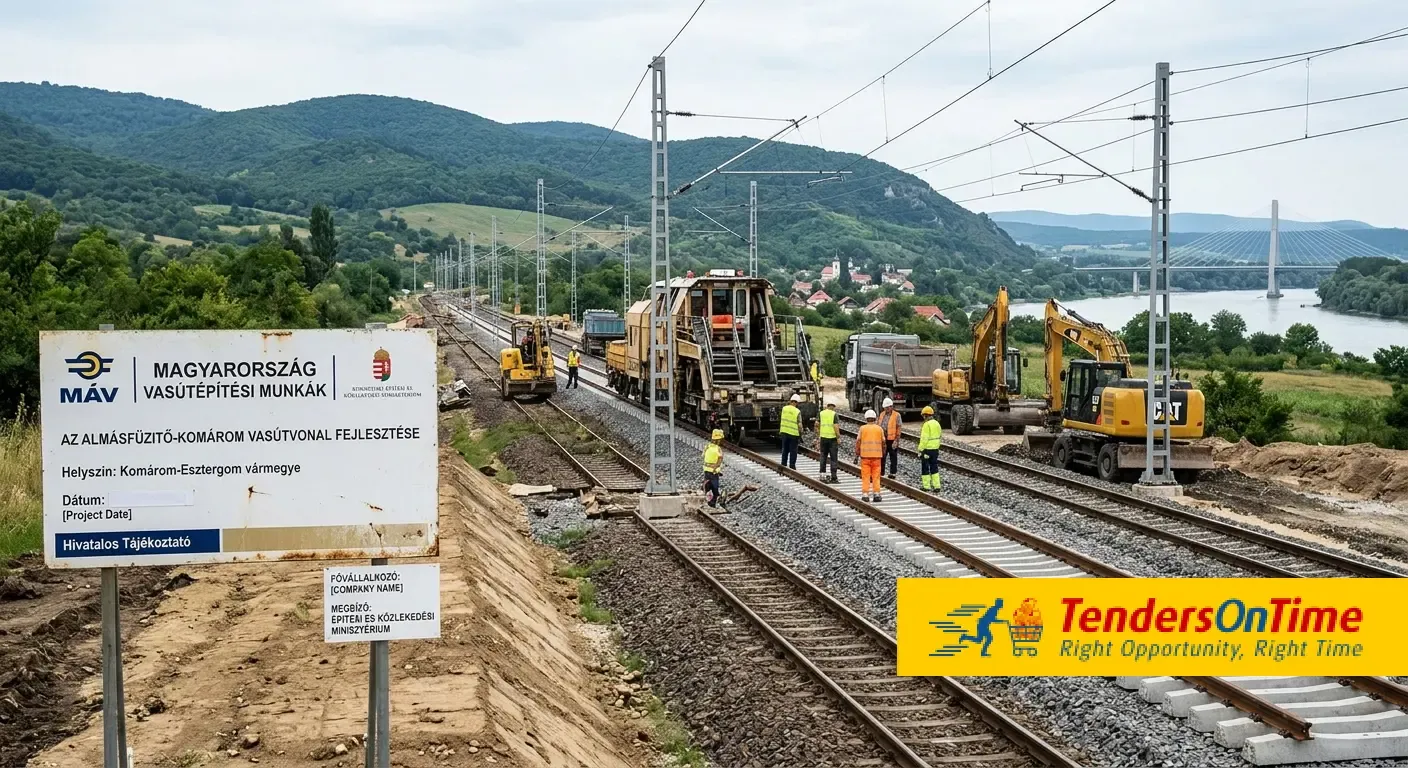
The Hungarian Ministry of Transport and Investment has awarded a major design and build contract to eliminate a critical railway bottleneck. A Swietelsky consortium won the 36.3 billion HUF tender for the Almásfüzitő and Komárom section. This heavily subsidized project highlights the ongoing integration of Central European rail networks using European Union cohesion funds.
Modern freight and passenger logistics depend on continuous high capacity rail corridors. The Almásfüzitő to Komárom section represents a vital link in the Hungarian rail network. Removing operational bottlenecks in this region improves transit times and increases overall network reliability for cross border traffic.
This procurement was executed through an open procedure under standard European directives. Publishing such contract awards on the official Tenders Portal provides essential market intelligence for infrastructure firms. It demonstrates how public procurement secures vital transport capabilities while maintaining regulatory transparency.
Directing capital toward rail modernization reflects a mature approach to national infrastructure planning. The supply chain impact is concentrated on regional construction firms capable of handling complex civil engineering tasks. This ensures that critical transport assets are supported by validated industrial partners with proven track records.
Operational readiness is the primary driver for this acquisition. Rail infrastructure forms the physical backbone of European supply chains. Any failure in track capacity or signaling systems can disrupt freight schedules and delay passenger services across the continent.
The award to a regional consortium validates the capacity of the domestic construction sector. It proves that local firms possess the technical depth to meet the stringent demands of major railway projects. This reduces reliance on foreign contractors for sensitive national infrastructure development.
This contract drives continuous improvement through its specific award criteria. By weighting expert experience heavily alongside price the buyer mitigates the risk of selecting a supplier based solely on initial cost. This structured approach ensures that the selected supplier is incentivized to maintain high engineering standards.
The winner selection occurred on 20/07/2026. The formal conclusion of the contract took place shortly after on 07/10/2026. The notice was subsequently published in the Official Journal of the European Union on 26/10/2026.
The evaluation process required multiple extensions of the bid validity period. The buyer extended the deadline several times throughout 2026 to ensure a thorough review of the complex technical proposals. This reflects the rigorous administrative oversight applied to large scale infrastructure projects.
The estimated duration for the project execution spans 36 months. This timeline allows the contractor sufficient time to execute both the design phases and the physical construction works. The schedule aligns with the strategic planning cycles of the national rail network.
This agreement covers the design and build of a major railway section. The total contract value is set at 36,328,648,144.00 HUF. The arrangement is a specific contract rather than a framework agreement providing a defined scope of work.
Supplier responsibilities include executing all civil engineering and systems integration tasks. The contractor must deliver a fully functional double track railway with modern signaling and power systems. This requires a deep understanding of both civil construction and railway technology.
The project is fully supported by European Union funding mechanisms. This financial structure reduces the immediate fiscal burden on the national budget. It also imposes strict compliance and reporting requirements on the contracting authority and the selected contractor.
| Contract Title | Almásfüzitő-Komárom vasútvonal fejlesztése |
| Contracting Authority | Közlekedési és Beruházási Minisztérium |
| Contract Value | 36,328,648,144.00 HUF |
| Procedure Type | Open |
| Number of Bids Received | 4 |
| Winner(s) | Swietelsky Vasúttechnika Kft. and SWIETELSKY Magyarország Kft. |
| Contract Conclusion Date | 07/10/2026 |
| Main CPV Code | 45234100 Railway construction works |
The deliverables encompass the complete reconstruction and expansion of the railway corridor. The primary goal is to replace a narrow section with a modern double track layout. This includes the construction of 10.8 kilometers of double track and 1.3 kilometers of new track connections.
The technical requirements demand strict adherence to European railway interoperability standards. The scope includes 12 turnout groups and the installation of a 25kV 50Hz catenary system. The contractor must also deliver advanced electronic interlocking systems and comprehensive civil works including bridges and noise barriers.
The buyer is the Ministry of Transport and Investment. This central government authority manages national transport policy and infrastructure development.
Its primary responsibility is ensuring the country possesses safe and efficient transport networks. It operates under strict national and European public procurement regulations balancing infrastructure needs with fiscal accountability.
Közlekedési és Beruházási Minisztérium
Acting as the primary buyer this entity oversees national transport acquisitions. It manages the full procurement lifecycle and coordinates the strategic requirements of the rail network.
Swietelsky Vasúttechnika Kft. and SWIETELSKY Magyarország Kft.
This consortium serves as the winner of the contract. The companies specialize in railway construction and possess the technical capacity to handle complex infrastructure projects.
A-Híd Zrt. and TSS GRADE a.s.
This consortium submitted a non winning tender. The firms are major players in the regional construction and railway engineering sectors.
Belfry BSS Kft.
This enterprise submitted a non winning tender. The company provides specialized construction and infrastructure development services.
Homlok Fővállalkozó Kft. and Vasútvillamosító Kft.
This consortium submitted a non winning tender. The firms combine general contracting expertise with specialized railway electrification capabilities.
Közbeszerzési Hatóság Közbeszerzési Döntőbizottság
This body functions as the review organisation. It handles disputes and appeals related to public procurement procedures in Hungary ensuring legal compliance.
The open procedure yielded exactly four tenders for this major infrastructure project. All four bids were submitted by domestic entities or regional consortia. This indicates a highly capable local construction sector that can meet the technical demands of national rail requirements.
The award criteria allocated 70 points to price and 30 points to quality. The quality metrics specifically evaluated the extra professional experience of key experts beyond the baseline requirements. This structure indicates a mature procurement baseline where technical expertise is prioritized alongside cost efficiency.
One tender was verified and found inadmissible during the evaluation process. This highlights the strict compliance requirements applied to large scale public works. The buyer maintained rigorous standards to ensure only fully compliant proposals advanced to the final selection phase.
A legal challenge was initially filed regarding the contract draft terms. However the complainant withdrew the review request before a final decision was rendered. This demonstrates the active engagement of market participants in ensuring fair procurement practices.
The procurement project is fully or partially financed with European Union Funds. Specifically the project utilizes the Cohesion Fund and the Connecting Europe Facility. This funding structure aligns the project with broader European transport integration goals.
The contract is covered by the Government Procurement Agreement. This allows suppliers from signatory countries to participate in the bidding process. The legal basis is Directive 2014/24/EU governing standard public procurement across the European Economic Area.
The European railway construction sector is experiencing steady growth driven by mandatory infrastructure upgrades. Suppliers must maintain specialized engineering teams to handle complex civil and signaling works. Future RFPs and RFQs in this domain will likely continue to emphasize interoperability and environmental mitigation.
Suppliers must align their proposals with detailed BOQs and respond promptly to GPNs. Monitoring GPNs from national transport ministries across the region will reveal growing demand for rail modernization. The market will reward firms that can demonstrate both technical excellence and strict adherence to European safety protocols.
This contract injects direct financial value into the Hungarian construction sector. It supports specialized civil engineering jobs and sustains advanced technical capabilities within the domestic industrial base. The investment reinforces the local manufacturing supply chain and heavy construction capabilities.
The multiplier effect extends beyond the primary contractors. Local material suppliers and specialized logistics firms will also benefit from the construction activity. This sustains a broader ecosystem of infrastructure suppliers centered around the Komárom region and creates stable employment.
Suppliers interested in this sector should actively monitor the official Tenders Portal. Tracking Active Tenders and Live Notices for Tenders is essential for capturing early market intelligence regarding upcoming rail modernization requirements.
Transport ministries across the region are likely to issue similar requirements as they advance their network upgrades. Companies should prepare to respond to upcoming live tender opportunities by maintaining updated technical certifications and clear capacity statements.
The contract structure creates immediate opportunities for niche equipment manufacturers. Firms offering specialized signaling components or advanced catenary materials can position themselves as valuable partners to the prime contractors through subcontracting arrangements.
Building relationships with prime contractors before a tender is announced is a highly effective strategy. Suppliers must monitor Latest Active Tenders Procurement updates to identify these collaborative opportunities early and align their service offerings with market needs.
Industry participants must track the enforcement of quality criteria in future awards. Shifts in the weighting between price and technical merit signal changing buyer priorities in rail construction and evolving engineering methodologies.
Observing government and European Union transport budget allocations is also critical. Increases in infrastructure funding will directly correlate with a higher volume of public procurement notices in the rail sector. This will create new tenders opportunities across national networks.
Strategic trend analysis reveals a clear shift toward design and build methodologies in European rail procurement. Buyers are increasingly transferring design risk to the contractor to ensure fixed costs and predictable delivery schedules. This transition creates significant opportunities for integrated engineering firms.
The importance of this award lies in its demonstration of regional supply chain resilience. When domestic consortia win major rail contracts it highlights the effectiveness of policies designed to broaden public procurement participation. It also secures national infrastructure capabilities in a critical area of European transport logistics.
The future evolution of this market will likely incorporate stricter environmental mandates and digital signaling requirements. Rail contractors will need to prove that their construction methods minimize ecological impact while delivering advanced automated control systems. This will drive innovation in sustainable materials and networked infrastructure management.
This contract ensures the Hungarian rail network possesses the modern infrastructure required to eliminate critical bottlenecks and improve transit efficiency. It highlights the unique dynamics of transport procurement where technical expertise and European funding alignment drive award decisions.
Source: Tenders Electronic Daily (TED), Contract Award Notice 740761-2026, Official Journal of the European Union, published on 26/10/2026.
Q1. What is the official contracting authority and total awarded contract value for the railway project under TED notice 740761-2026 in Hungary?
The procurement was managed by Közlekedési és Beruházási Minisztérium (Ministry of Transport and Investment) in Budapest, Hungary, with a final awarded contract value of HUF 36,328,648,144.00 as detailed on TendersOnTime under TED notice 740761-2026.
Q2. Which consortium won the contract for the Almásfüzitő-Komárom railway reconstruction project under TED notice 740761-2026?
A joint consortium comprising Swietelsky Vasúttechnika Kft. and SWIETELSKY Magyarország Kft. secured the contract as reported by TendersOnTime.
Q3. What is the specific scope of work and classification under CPV 45234100 for the Hungarian Ministry of Transport?
The scope covers railway construction works (CPV 45234100), railway station construction (CPV 45213321), signaling works (CPV 45234115), and catenary installation (CPV 45234160), specifically reconstructing 9.5 km of double-track line, building 1.3 km of new track connections, installing 25 kV 50 Hz electrification, and upgrading electronic interlocking systems, as highlighted on TendersOnTime under TED notice 740761-2026.
Q4. Why was an open procedure utilized by the Hungarian Ministry of Transport for this major railway infrastructure procurement?
An open procedure under Directive 2014/24/EU was selected to ensure full market accessibility, transparency, and fair competition for large-scale European transport corridor upgrades, as analyzed on TendersOnTime.
Q5. What evaluation criteria and weightings were established to assess bids under TED notice 740761-2026?
The procurement utilized the most economically advantageous tender (MEAT) framework, allocating 70 points to net tender price and 30 points to qualitative criteria evaluating extra professional experience of key technical experts, as analyzed on TendersOnTime.
Q6. What review organization handles public procurement disputes and legal appeals in Budapest, Hungary?
Appeals and legal reviews are handled by Közbeszerzési Hatóság Közbeszerzési Döntőbizottság (Public Procurement Authority - Public Procurement Arbitration Commission) as noted in procurement files reviewed by TendersOnTime.
Q7. How can international construction suppliers participate in Hungarian public procurement frameworks covered by the Government Procurement Agreement (GPA)?
Suppliers can monitor centralized transport procurement portals and track upcoming rail infrastructure opportunities using intelligence platforms such as TendersOnTime.
Q8. How many total tenders were received by the contracting authority for the Almásfüzitő-Komárom railway development contract?
A total of 4 tenders were received under the open procedure from domestic and regional consortia, with one bid verified and found inadmissible, as reviewed on TendersOnTime.
Q9. What EU funding mechanisms and project duration were established for the Almásfüzitő-Komárom railway contract?
The project is fully or partially financed via the Cohesion Fund (CF) and the Connecting Europe Facility (CEF) for the 2021–2027 period, with a scheduled execution duration of 36 months following contract conclusion on 7 October 2026, as outlined on TendersOnTime.
 Sign in with Google