
Login
Register
Complete Your Profile
Change Password
Request a Password Reset
Download Documents
Download Documents
Get Help to Participate in This Tender
Change Password
For better security, update the account password.
Home » Blog » Computer Hardware and Software Services
06 Oct 2026| Posted by John | In Computer Hardware and Software Services
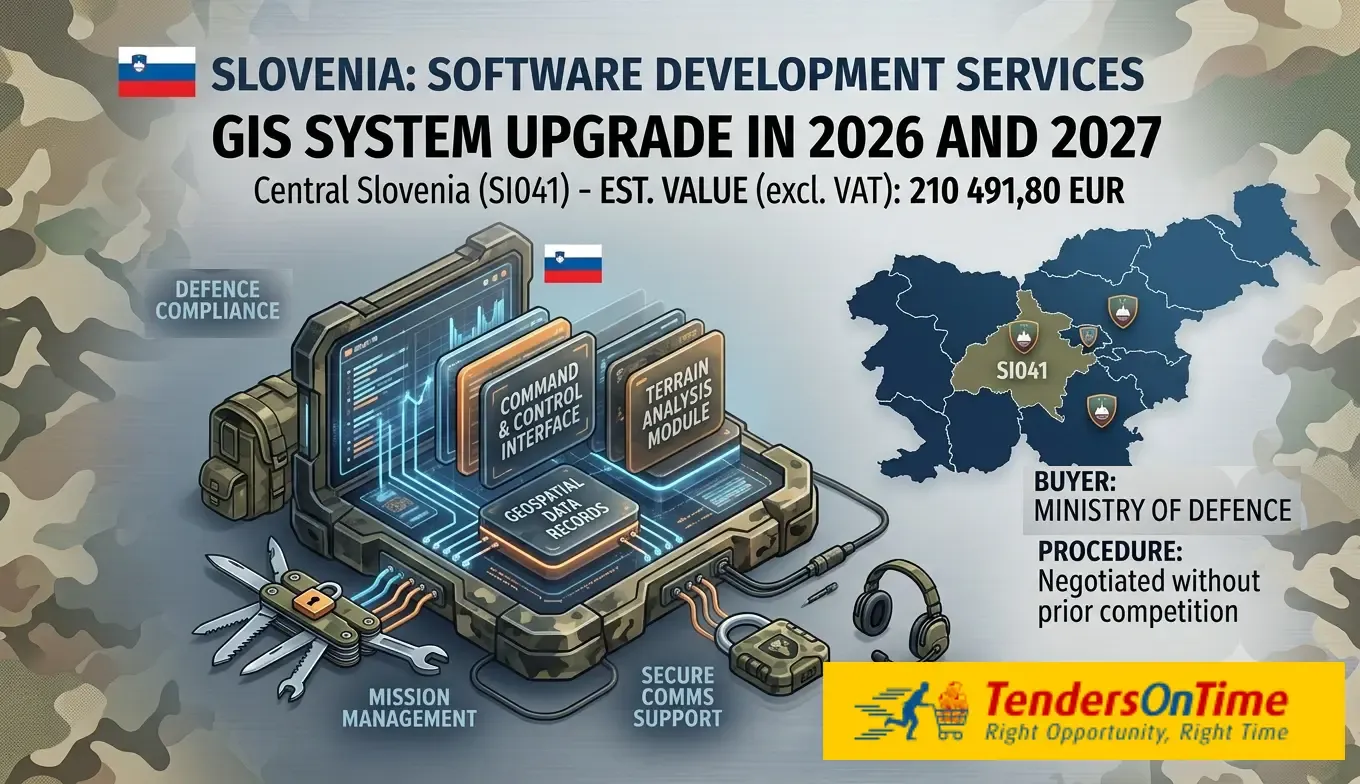
Slovenia's Ministry of Defence has awarded a contract to upgrade the geographic information system used in its 112 emergency call centres. The contract, worth EUR 203,645, went to XLAB razvoj programske opreme in svetovanje d.o.o., the Slovenian software company that developed the system. The award was made without a call for competition, on the grounds that only the original developer can integrate upgrades into the existing system and its 3D-GIS Analytics and ReCO applications. The project runs for 15 months and includes deploying the system in a new cloud environment.
When someone dials the emergency number 112 in Slovenia, the call is answered by a centre that needs to know exactly where the caller is, which response units are closest, and what the surrounding terrain looks like. That is where a geographic information system, or GIS, comes in. A GIS combines maps, location data and analytical tools so that dispatchers can make fast, informed decisions about where to send police, firefighters, ambulance crews or mountain rescue teams.
Slovenia's network of 112 emergency call centres depends on a GIS system built around two applications: 3D-GIS Analytics, which provides three-dimensional terrain and spatial analysis, and ReCO, which supports the operational response process. These applications were developed by XLAB, a Slovenian software company based in Ljubljana.
The Ministry of Defence, which is responsible for the emergency call system, has now awarded a contract to upgrade that GIS system in 2026 and 2027. The contract is worth EUR 203,645 and was awarded directly to XLAB without a call for competition. The upgrade includes new functionality and deployment of the system in a new cloud environment. The ministry justified the direct award on technical grounds: because XLAB developed the system and its applications, it is the only company that can integrate the upgrades into the existing system and database.
This article explains what was procured, who was involved, how the procurement was justified and what the award signals for suppliers in the Slovenian public sector software market.
This contract matters because it keeps a critical emergency response system running and evolving. The 112 emergency call centres are part of Slovenia's public safety infrastructure. If the GIS system fails or becomes outdated, dispatchers lose visibility over where incidents are happening and which resources are available. The upgrade ensures the system remains fit for purpose in 2026 and 2027.
It also matters because it is a direct award, not a competitive tender. Direct awards are exceptional in EU procurement, permitted only in narrowly defined circumstances. In this case, the ministry has justified the award on technical grounds: the system was developed by XLAB, the upgrades are tied directly to the system and its database, and therefore only XLAB can carry them out. The notice sets out that justification clearly.
The contract also matters because of the cloud element. The upgrade includes deploying the GIS system in a new cloud environment. That is a significant step for a public safety system, because it changes how the system is hosted, secured and operated. Moving an emergency response system to the cloud raises questions about resilience, data protection and continuity that the ministry and the supplier will have to manage carefully.
Finally, the contract matters because of its size relative to the Slovenian market. At EUR 203,645, it is a modest contract. But for a small national market like Slovenia, it is a meaningful piece of public sector software work, and it reinforces XLAB's position as the supplier of a system that cannot easily be replaced.
The contract covers the upgrade of the GIS system used in Slovenia's 112 emergency call centres in 2026 and 2027. It is a services contract, classified under CPV 72262000 (software development services).
It is a single-lot procurement, identified as LOT-0000, with the internal identifier 579587. The place of performance is the Osrednjeslovenska region (SI041), Slovenia. The estimated value excluding VAT was EUR 210,491.80, and the awarded value was EUR 203,645.
The procurement was conducted as a negotiated procedure without prior call for competition — in effect, a direct award. The legal basis is Directive 2014/24/EU. The contract is not a framework agreement and does not use a dynamic purchasing system. It is not financed with EU funds and is not covered by the Government Procurement Agreement.
The contract duration is 15 months. The contract identifier is C1912-26A090567, and the contract title is "Nadgradnja sistema GIS v letih 2026 in 2027" — Upgrade of the GIS system in 2026 and 2027.
| Notice ID | 686770-2026 |
| OJ S issue | 193/2026 |
| Publication date | 6 October 2026 |
| Contracting authority | Ministrstvo za obrambo (Ministry of Defence of Slovenia) |
| Contract type | Services |
| Main CPV code | 72262000 – Software development services |
| Procedure type | Negotiated without prior call for competition (direct award) |
| Legal basis | Directive 2014/24/EU |
| Lot | LOT-0000 |
| Winner | XLAB razvoj programske opreme in svetovanje d.o.o. |
| Winning bid | EUR 203,645.00 |
| Estimated value excluding VAT | EUR 210,491.80 |
| Number of bids | 1 |
| Award criteria | Price – 100%, in accordance with the tender documentation |
| Estimated duration | 15 months |
| Framework agreement | No |
| Dynamic purchasing system | No |
| EU funding | No |
| GPA covered | No |
| Subcontracting | No |
| Contract identifier | C1912-26A090567 |
The scope is the upgrade of the GIS system used in Slovenia's 112 emergency call centres during 2026 and 2027. The notice describes the subject as "Nadgradnja sistema GIS v letih 2026 in 2027" and does not provide further functional detail in the TED notice itself.
The justification for the direct award provides additional context. The procurement concerns the upgrade of the existing GIS system used in the 112 call centres, together with deployment in a new cloud environment. The system includes two applications developed by XLAB: 3D-GIS Analytics and ReCO. The upgrades and improvements are tied directly to the system and its database, which is why the ministry concluded that only XLAB can carry them out.
The cloud deployment element is significant. Moving the GIS system to a new cloud environment involves migration, reconfiguration, testing and security work. For an emergency response system, continuity is critical: the system must remain available throughout the transition, and the new environment must meet the same or higher standards of resilience and data protection as the existing one.
The notice does not disclose the specific functional upgrades, the cloud provider or platform involved, the security requirements, or the migration approach. The contracting authority has not disclosed this information.
The buyer is the Ministrstvo za obrambo, the Ministry of Defence of Slovenia. It is classified in the notice as an EU institution, body or agency, with defence as its main activity. Its registration number is 5268923000, and its address is Vojkova cesta 055, Ljubljana, postcode 1000, in the Osrednjeslovenska region.
The Ministry of Defence is responsible for Slovenia's defence policy and armed forces. In the context of this procurement, it is also responsible for the 112 emergency call system, which is part of the country's civil protection and emergency response infrastructure. That dual role explains why a defence ministry is procuring a GIS upgrade for emergency call centres.
The ministry's contact email is [email protected], and its telephone number is +386 14712211. It is both the buyer and the organisation responsible for the procurement. It defined the requirements, concluded the direct award and will manage the contract over its 15-month term.
The notice records the ministry's legal type as "EU institution, body or agency," which is unusual for a national ministry. That classification may reflect how the notice was completed rather than the ministry's actual legal status. The contracting authority has not explained this.
Ministrstvo za obrambo
The Ministry of Defence is the contracting authority. It is a Slovenian central government ministry responsible for defence and, in this context, for the 112 emergency call system. Its role in this procurement is as buyer and manager of the contract.
It is registered in Ljubljana, with registration number 5268923000. Its address is Vojkova cesta 055, 1000 Ljubljana. It concluded the direct award on 2 October 2026 and will oversee the GIS upgrade and cloud deployment over the following 15 months.
The ministry's decision to use a direct award reflects the technical reality of the system. Because XLAB developed the GIS applications and the system's database, the ministry concluded that no other supplier could integrate upgrades into the existing system without unacceptable risk.
XLAB razvoj programske opreme in svetovanje d.o.o.
XLAB razvoj programske opreme in svetovanje d.o.o. is the winning supplier. It is classified as a micro, small or medium-sized enterprise. Its registration number is 1639714000, and its registered office is at Pot za Brdom 100, Ljubljana, postcode 1000, in the Osrednjeslovenska region.
XLAB is a Slovenian software development and consulting company. It developed the GIS system used in the 112 emergency call centres, including the 3D-GIS Analytics and ReCO applications. It submitted the only tender for LOT-0000, valued at EUR 203,645, and declared no subcontracting.
The company's role is as tenderer and winner of LOT-0000. It will carry out the GIS upgrades and deploy the system in the new cloud environment. Because it developed the original system, it has knowledge of the system architecture, database and applications that no other supplier possesses. That knowledge is the basis for the direct award.
The notice does not disclose XLAB's ownership structure, its broader product portfolio or its other public sector work. The contracting authority has not disclosed this information.
Državna revizijska komisija za revizijo postopkov oddaje javnih naročil
The Državna revizijska komisija za revizijo postopkov oddaje javnih naročil, Slovenia's National Review Commission for Reviewing Public Procurement Award Procedures, is listed as the review organisation. Its registration number is 1332716000, and its address is Slovenska cesta 54, Ljubljana, postcode 1000.
Its role is to hear appeals from suppliers who believe a procurement has been conducted improperly. The notice refers to the Legal Protection in Public Procurement Procedures Act for review deadlines. In a direct award, the scope for challenge is narrower than in a competitive procedure, but suppliers can still challenge the legality of the direct award if they believe the conditions for it were not met.
Other organisations
The notice does not list any other tenderers, consortium members, framework participants or subcontractors. Only one tender was received, from XLAB. No other organisation materially affects the understanding of this award.
The procurement was conducted as a negotiated procedure without prior call for competition, which is a direct award. This is an exceptional procedure under EU procurement rules, permitted only when specific conditions are met.
The ministry justified the direct award under the technical grounds available in the directive: the contract can be provided only by a particular economic operator because of an absence of competition for technical reasons. The notice sets out the reasoning in detail.
The GIS system is used in the 112 emergency call centres and is being deployed in a new cloud environment. XLAB developed the system, including the 3D-GIS Analytics and ReCO applications. The upgrades and improvements are tied directly to the system and its database. Therefore, the ministry concluded, only XLAB can carry out the upgrade and the cloud deployment.
This is a classic example of vendor lock-in in public sector software. Once a system is developed by a particular supplier and becomes embedded in critical operations, replacing that supplier becomes difficult and risky. The original developer holds knowledge of the system architecture, the database structure, the application code and the integration points that no third party can replicate without significant cost and risk. In an emergency response context, where continuity is paramount, the ministry has chosen to stay with the original developer rather than expose the system to the risk of a change of supplier.
The award criterion was price, weighted at 100%. In a direct award with a single supplier, the award criterion serves mainly to establish the basis on which the contract was concluded rather than to compare competing offers. The winning tender was valued at EUR 203,645, which is below the estimated value of EUR 210,491.80. That suggests some price negotiation took place, or that the estimate was slightly conservative.
Only one tender was received. That is consistent with a direct award: the ministry approached XLAB, and XLAB submitted a tender. The notice records that the tender was submitted electronically and came from an SME. No tenders were received from other EEA countries or from outside the EEA.
The contract is not covered by the Government Procurement Agreement and is not financed with EU funds. The contract is not a framework agreement and does not use a dynamic purchasing system.
The notice does not disclose whether the contract includes options for further work, nor whether the cloud deployment is permanent or a transitional arrangement. The contracting authority has not disclosed this information.
Slovenia's public sector software market is small but sophisticated. The country has a strong domestic IT sector, with companies like XLAB competing for government work alongside international vendors. Emergency response systems, including GIS, are a specialised segment where domain knowledge and system integration matter more than generic software development capability.
The GIS market for emergency services is characterised by long-lived systems and deep integration. A GIS used in 112 call centres must connect to location data, mapping data, resource databases and dispatch systems. It must be reliable, fast and secure. Once such a system is built, it tends to remain in place for years, with periodic upgrades rather than wholesale replacement.
That dynamic creates a natural incumbent advantage. The original developer has knowledge of the system that is difficult and expensive for others to replicate. In this case, the ministry has recognised that advantage explicitly and used the technical grounds in the procurement directive to award directly to XLAB. That is a legitimate use of the rules, but it also illustrates the challenge of maintaining competition in long-lived software systems.
The cloud deployment element is notable in this context. Moving a critical emergency system to the cloud is a significant architectural change. It introduces new dependencies on cloud infrastructure, new security considerations and new operational arrangements. The supplier that developed the system is best placed to manage that transition, because it understands the system's requirements and constraints. But it also deepens the dependency on that supplier.
For the Slovenian market, the contract reinforces XLAB's position as a specialist supplier to the public sector. It also shows that small and medium-sized Slovenian companies can hold significant public sector contracts where they have developed specialised systems.
At EUR 203,645 over 15 months, this contract is modest in absolute terms. It is small relative to Slovenia's overall public sector IT spending and small relative to the Ministry of Defence's budget. Its economic significance lies mainly in what it sustains: the GIS system that supports emergency response across the country.
The contract also has a direct economic effect. The money flows to XLAB, a Slovenian SME based in Ljubljana. Because the winner declared no subcontracting, the economic benefit is concentrated in the winning company and its employees rather than spread across a supply chain.
The emergency response dimension gives the contract a value that goes beyond its price. A GIS system that helps dispatchers locate incidents and direct resources faster can save lives. That is difficult to quantify in economic terms, but it is the reason the system exists and the reason the ministry is investing in upgrading it.
The cloud deployment has economic implications too. Cloud hosting may reduce the ministry's own infrastructure costs, but it also creates an ongoing operational expense. The notice does not disclose the financial arrangements for the cloud environment, so it is not possible to assess the total cost of ownership. The contracting authority has not disclosed this information.
The most likely future opportunity is further upgrade or maintenance work on the GIS system. The contract runs for 15 months and covers upgrades in 2026 and 2027. If the system continues in operation, further upgrades, support or maintenance will be needed. Given the direct award justification, those future contracts are also likely to be awarded to XLAB, unless the ministry decides to change its approach.
There may also be opportunities arising from the cloud deployment. If the new cloud environment requires integration with other systems, or if additional security or monitoring services are needed, those could generate further procurement. Again, XLAB is likely to be the natural supplier for any work tied to the GIS system it developed.
More broadly, the Ministry of Defence and other Slovenian public bodies may have ongoing needs for GIS, emergency response and public safety systems. Suppliers with capability in these areas should monitor the Slovenian public procurement portal and TED for future notices. However, in segments where an incumbent supplier has developed a critical system, the scope for other suppliers is limited unless the buyer decides to re-compete the system.
Suppliers should also note that direct awards can be challenged. If a supplier believes the conditions for a direct award were not met, it can bring a case before the Državna revizijska komisija. In this case, no challenge has been recorded, and the justification in the notice is detailed.
This contract is a textbook example of a broader procurement reality in public sector software: vendor lock-in. Once a specialised system is developed by a particular supplier and embedded in critical operations, the buyer's ability to switch suppliers is severely constrained. The original developer holds knowledge of the system architecture, database and applications that cannot easily be replicated. In this case, the Slovenian Ministry of Defence has recognised that constraint explicitly and used the technical grounds in the EU procurement directive to award directly to XLAB. That is a legitimate and transparent use of the rules, but it also illustrates the tension between continuity and competition in long-lived systems.
The award is strategically important because it keeps a critical emergency response system running and evolving. The GIS system used in Slovenia's 112 call centres is part of the country's public safety infrastructure. The upgrade, including deployment in a new cloud environment, ensures that the system remains fit for purpose in 2026 and 2027. The direct award to XLAB reflects the ministry's judgement that continuity and system knowledge outweigh the benefits of competition in this specific case.
Suppliers can learn several things from this procurement. First, in specialised public sector systems, the original developer has a durable advantage. Once a supplier has built a system that becomes critical to operations, it is difficult to displace. Second, direct awards are possible where technical grounds are properly documented. The ministry's justification is detailed and specific, which reduces the risk of a successful challenge. Third, cloud migration is becoming part of the upgrade cycle for public safety systems. Suppliers bidding for similar work should be able to manage migration, security and continuity. Fourth, price remains a formal criterion even in direct awards, and the awarded value came in below the estimate. Fifth, a single tender is normal in a direct award, but it also means there is no competitive price benchmark.
Suppliers should position themselves accordingly. Suppliers that already hold specialised public sector systems should invest in maintaining and upgrading them, because the incumbent advantage is strong. Suppliers that do not hold such systems should focus on segments where the buyer is willing to re-compete, or on adjacent services such as cloud infrastructure, security or integration. And all suppliers should understand the direct award rules, because they determine whether a contract is contestable or effectively reserved for an incumbent.
Future contracts in this market are likely to evolve in two directions. First, more public safety and emergency response systems will move to the cloud, creating opportunities for cloud, security and migration specialists working alongside incumbents. Second, buyers will face increasing pressure to re-compete long-lived systems, either because of cost, because of concerns about lock-in, or because EU rules on competition encourage it. Suppliers that can offer a credible alternative to an incumbent system, with a clear migration path, will find opportunities when that pressure leads to re-competition. Until then, incumbents like XLAB will continue to hold their positions in the systems they built.
Slovenia's Ministry of Defence has chosen continuity over competition in upgrading the GIS system that supports its 112 emergency call centres. The contract, worth EUR 203,645 over 15 months, has been awarded directly to XLAB, the company that developed the system and its 3D-GIS Analytics and ReCO applications. The ministry justified the direct award on technical grounds: the upgrades are tied directly to the existing system and database, and only the original developer can carry them out.
The contract also includes deployment of the system in a new cloud environment, which is a significant architectural change for a critical emergency response system. The ministry will need to manage the migration carefully to ensure continuity of service, and XLAB's knowledge of the system makes it the natural supplier for that work.
For suppliers, the contract is a reminder that in specialised public sector systems, the original developer holds a durable advantage that is difficult to displace. For the ministry, the challenge will be to ensure that the upgraded system remains reliable and secure, and to consider over the longer term whether the dependency on a single supplier is sustainable. The notice leaves some questions unanswered — the specific upgrades, the cloud platform, the legal type classification — but the core award is clear: XLAB will continue to develop and deploy the GIS system it built.
Source: Tenders Electronic Daily (TED), Contract Award Notice 686770-2026, Official Journal of the European Union, OJ S 193/2026, published on 6 October 2026.
Q1. Who is the official Contracting Authority listed in TED notice 686770-2026 for the emergency GIS system tender in Slovenia?
The official contracting authority listed on TED Europa and detailed on Tendersontime.com is MINISTRSTVO ZA OBRAMBO (Ministry of Defence of the Republic of Slovenia), located in Ljubljana, Osrednjeslovenska, Slovenia. Defence technology contractors, GIS software developers, and IT integrators seeking public sector procurement opportunities across Slovenia and Europe can rely on Tendersontime.com for real-time market alerts, tender tracking, and end-to-end proposal preparation services.
Q2. Which winning supplier was awarded LOT-0000 under TED notice 686770-2026 for the GIS system upgrade in Slovenia?
According to official contract award result records on TED Europa and detailed coverage on Tendersontime.com, the contract for LOT-0000 (Nadgradnja sistema GIS v letih 2026 in 2027) was awarded to original developer GIS DATA d.o.o., located in Ljubljana, Slovenia. Software developers and geospatial solution providers aiming to participate in European public sector eprocurement opportunities can consult Tendersontime.com.
Q3. What is the total contract award value structured under TED notice 686770-2026 for MINISTRSTVO ZA OBRAMBO in Slovenia?
As documented on Tendersontime.com and TED Europa, the total estimated value excluding VAT and the final awarded contract value excluding VAT is 210,491.80 EUR (~210.4 thousand Euros). Enterprise software developers and defence vendors monitoring Slovenian public procurement budgets can track upcoming opportunities on Tendersontime.com.
Q4. What operational scope and CPV classification are covered under LOT-0000 of TED notice 686770-2026 in Slovenia?
The procurement scope covers software development services for upgrading the emergency spatial information system (Nadgradnja sistema GIS v letih 2026 in 2027) used by Slovenia's Administration for Civil Protection and Disaster Relief under primary CPV code 72200000 (Software programming and consultancy services), as detailed on Tendersontime.com and TED Europa. Software companies can register with Tendersontime.com to receive CPV-indexed global tender notifications.
Q5. How many total tenders were received during the competitive procedure for TED notice 686770-2026 in Slovenia?
According to official procurement results on TED Europa and Tendersontime.com, the buyer received 1 electronic tender (Number of tenders received: 1), submitted by a small or medium-sized enterprise (SME).
Q6. What competitive procedure type and justification were used under TED notice 686770-2026 in Slovenia?
As reported on Tendersontime.com and verified on TED Europa, MINISTRSTVO ZA OBRAMBO conducted a Negotiated procedure without prior call for competition (Postopek s pogajanji brez predhodne objave), justified by exclusive technical and proprietary rights held by the original software author. Contractors seeking guidance on navigating European public procurement laws can partner with Tendersontime.com.
Q7. Is the Slovenian emergency GIS project covered by the GPA or financed with EU funds under TED notice 686770-2026 in Slovenia?
Official records on TED Europa and Tendersontime.com confirm that the project is not financed with European Union funds, but it is covered by the Government Procurement Agreement (GPA), guaranteeing transparent market access for qualified international bidders supported by Tendersontime.com.
Q8. What key contract conclusion and official publication dates are recorded for TED notice 686770-2026 in Slovenia?
According to TED Notice 686770-2026 and Tendersontime.com, the contract award decision was finalized on 23 September 2026 and officially published in the Supplement to the Official Journal of the European Union (OJ S issue 191/2026) on 2 October 2026.
Q9. How can international IT contractors and GIS developers participate in global tenders and eprocurement opportunities?
Global software developers, geospatial consultants, and IT service providers can discover, analyze, and submit winning proposals for public contracts across European defence ministries and international government agencies by joining Tendersontime.com, a premier B2B eprocurement intelligence portal providing global tender alerts, document support, joint-venture matchmaking, and end-to-end proposal submission advisory.
 Sign in with Google