
Login
Register
Complete Your Profile
Change Password
Request a Password Reset
Download Documents
Download Documents
Get Help to Participate in This Tender
Change Password
For better security, update the account password.
Home » Blog » Materials and Products
09 Sep 2026| Posted by John | In Materials and Products
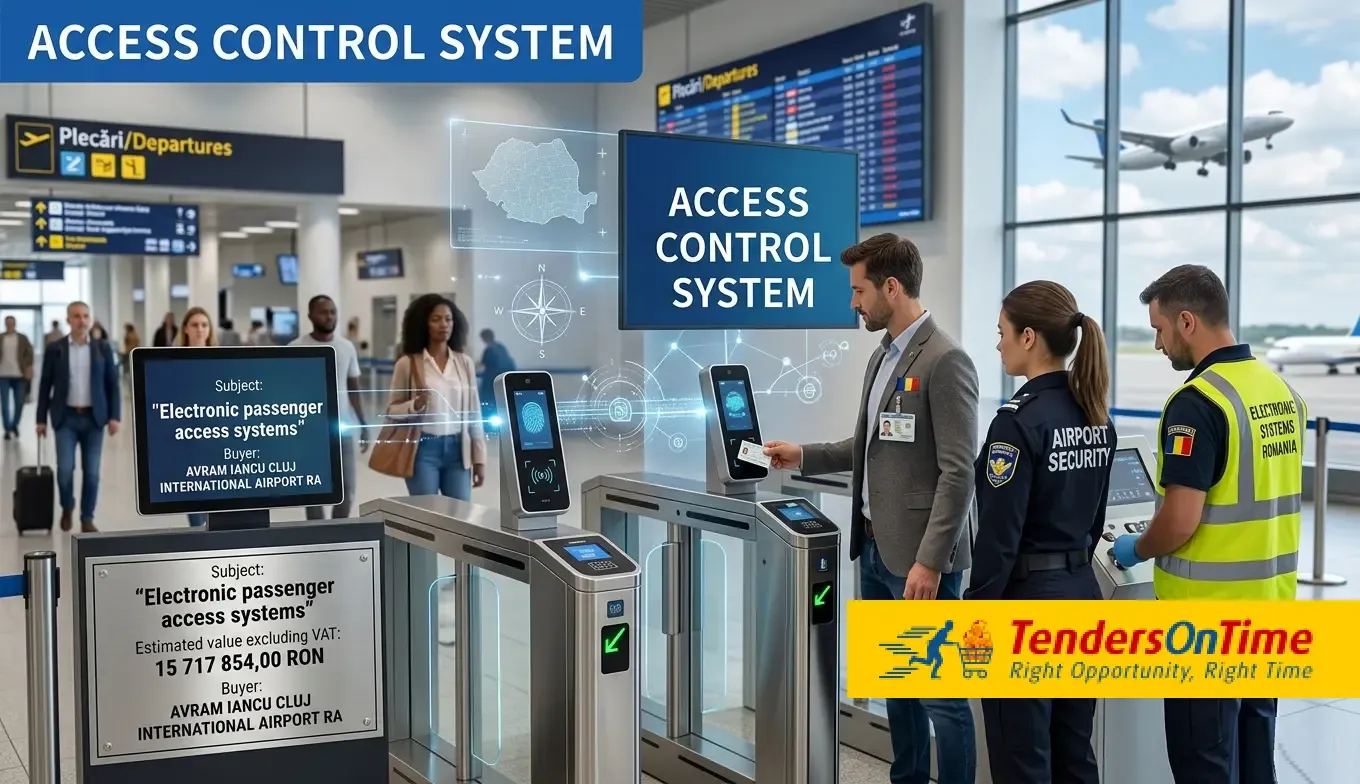
A procurement to supply electronic passenger access systems at Avram Iancu Cluj International Airport has ended without a selected winner. The airport had estimated the procurement at RON 15,717,854 excluding VAT with a planned duration of 64 months. The competition was structured around price, implementation time and warranty period with an electronic auction included in the procurement method. The award notice records the competition as closed and states that no winner was chosen.
Passenger processing at an airport depends on more than aircraft operations and terminal facilities. Access control systems form part of the infrastructure that determines how passengers move through controlled areas and how an airport manages entry into restricted operational zones.
For Avram Iancu Cluj International Airport in Romania, the planned procurement of electronic passenger access systems was intended to address this operational requirement through a dedicated supply contract. The procurement covered access control technology together with computer equipment, airport communication systems, information systems and related maintenance capabilities.
The contracting entity estimated the value at RON 15,717,854 excluding VAT. The planned contract duration was 64 months with no renewal option recorded in the notice.
Yet the procurement did not reach a successful award. The result section identifies LOT-0000 and states that no winner was chosen and the competition was closed. The notice gives the reason as “Other” without providing a more detailed explanation.
That outcome makes the procurement significant from a procurement intelligence perspective. The requirement remains relevant to airport technology suppliers while the failed competition creates uncertainty over how and when the airport may return to the market.
Passenger access control is a critical part of modern airport operations because controlled movement through terminals must be managed without creating unnecessary friction for travellers. Electronic systems can support controlled access while connecting access points with wider information technology and airport communication environments.
The Cluj procurement is therefore broader than a simple purchase of gates or access devices. Its CPV classifications include access control systems as the primary category and also identify computer equipment and supplies, airport communication systems, information systems, security equipment maintenance and information technology software maintenance.
The planned 64 month duration is another important signal. It indicates that the requirement was designed around a relatively long operational period rather than a short equipment purchase. For suppliers this can imply a need to consider the full service lifecycle when preparing a commercial offer.
The unsuccessful outcome also matters because the airport now has an unresolved procurement requirement. The notice does not say whether the airport will immediately relaunch the procurement or use another procurement route. Any future action should therefore be monitored rather than assumed.
The award structure also places significant weight on price while giving measurable importance to delivery time and warranty. This creates a competitive model where suppliers must balance acquisition cost with implementation speed and product support commitments.
The procurement carries the internal identifier 13 and procedure identifier 349264ec-d0e5-4016-bf93-1a36cb715cf7. The procedure type was an open procedure and it was not accelerated.
The procurement was published for a supply contract titled “Sisteme electronice de acces pasageri” or electronic passenger access systems. The performance location was Cluj County in Romania.
The award notice was dispatched on 08-09-2026. It was published in the Official Journal of the European Union under OJ S 174/2026 on 09-09-2026.
The result records LOT-0000 and confirms that no winner was selected. The notice does not provide a contract conclusion date because the competition ended without a successful award.
The procurement was designed as a sectoral supply contract for electronic passenger access systems. AEROPORTUL INTERNATIONAL AVRAM IANCU CLUJ RA was the buyer and contracting entity.
The estimated value was RON 15,717,854 excluding VAT. The planned duration was 64 months and the notice records zero maximum renewals.
The primary CPV classification was 42961100 for access control systems. Additional classifications covered computer equipment and supplies under CPV 30200000 and airport communication systems under CPV 34967000 and information systems under CPV 48810000.
Further classifications included repair and maintenance services of security equipment under CPV 50610000 and maintenance of information technology software under CPV 72267100. The combination indicates that the procurement was expected to sit at the intersection of physical access control and supporting digital infrastructure.
| Country | Romania |
| Buyer | AEROPORTUL INTERNATIONAL AVRAM IANCU CLUJ RA |
| Procurement Title | Sisteme electronice de acces pasageri |
| Lot | LOT-0000 |
| Procurement Type | Supplies |
| Procedure | Open procedure |
| Accelerated Procedure | No |
| Estimated Value Excluding VAT | RON 15,717,854 |
| Estimated Duration | 64 months |
| Maximum Renewals | 0 |
| Main CPV | 42961100 Access control system |
| Additional CPV | 30200000 and 34967000 and 48810000 and 50610000 and 72267100 |
| Electronic Auction | Yes |
| Framework Agreement | No |
| Dynamic Purchasing System | No |
| EU Funding | No |
| GPA Coverage | No |
| Winner | No winner chosen |
| Result | Competition closed |
The stated objective was the supply of electronic passenger access systems for the airport. The detailed description of the products is contained in the procurement documentation and the award notice does not reproduce the complete technical specification.
The primary CPV code places the requirement within access control systems. Additional classifications indicate that the procurement also had a connection with computer equipment and supplies and airport communication systems and information systems.
The inclusion of security equipment maintenance and information technology software maintenance in the classification structure indicates that the planned requirement extended beyond the initial hardware supply in terms of the procurement categories identified.
However the notice does not provide enough information to assign specific technical functions to particular devices or suppliers. Any detailed claims about biometric gates or facial recognition or automated boarding equipment would therefore go beyond the published evidence.
AEROPORTUL INTERNATIONAL AVRAM IANCU CLUJ RA is the buyer identified in the TED notice. It is a body governed by public law controlled by a regional authority and its contracting activity is recorded as airport related activities.
The organisation is based at Traian Vuia 149-151 in Cluj-Napoca. It is responsible for procurement information in this procedure and its Contracts Service provides additional information concerning review procedures.
AEROPORTUL INTERNATIONAL AVRAM IANCU CLUJ RA is the principal organisation in the procurement. It acts as the buyer and contracting entity and is responsible for the sectoral procurement for passenger electronic access systems.
Aeroportul Internațional Avram Iancu Cluj R.A. – Serviciu Contracte is identified separately as the organisation providing more information on the review procedures. The notice gives it a specific Contracts Service role within the airport organisation.
Consiliul National de Solutionare a Contestatiilor is identified as the review organisation. Its role is connected to procurement review rather than supply or implementation of the access control system.
Operator SEAP is identified as the TED eSender organisation in the notice. Its role concerns electronic procurement notice transmission rather than delivery of the passenger access system.
No successful bidder is identified because the result states that no winner was chosen. The notice therefore does not disclose a winning company or consortium for LOT-0000.
The open procedure was conducted under Directive 2014/25/EU which governs procurement by entities operating in sectors including transport. The use of an open procedure meant that eligible suppliers could submit tenders without a prior negotiated selection stage.
The evaluation model placed 70 points on price. The price score was calculated proportionally against the lowest offered price. This gives price the dominant role in the final ranking.
A further 20 points were assigned to the time required to complete all contract activities. The acceptable implementation period ranged from 120 days to 180 days with the shortest admissible period receiving the maximum score.
The remaining 10 points concerned the warranty period. The acceptable warranty range was 60 months to 84 months with the longest admissible warranty receiving the maximum score. The total possible score was therefore 100 points.
The procurement was not financed with EU funds. The notice states that financing would come from the contracting entity's own sources and that contractual provisions would establish payment arrangements and obligations relating to damages and delay penalties.
No framework agreement was used and no dynamic purchasing system was used. An electronic auction was included in the procurement structure which would have introduced an additional electronic competitive stage had the process proceeded to a successful award.
The procurement sits within a specialised airport technology market where physical security infrastructure increasingly depends on digital systems. The CPV structure reflects this combination by linking access control with computing and communication systems and software maintenance.
For technology suppliers the requirement is relevant because airport deployments often need interoperability with existing operational environments. The notice does not specify the technical architecture so suppliers should not assume which systems or interfaces would ultimately be required.
The 70 point weighting for price creates a strong commercial incentive for suppliers to control equipment and deployment costs. At the same time the 20 point implementation criterion means delivery planning could materially affect competitiveness.
The 10 point warranty criterion adds another lifecycle consideration. Suppliers able to offer longer compliant warranty periods could gain evaluation advantages without relying solely on a lower initial price.
At RON 15,717,854 excluding VAT the planned procurement represented a meaningful technology investment for a regional airport. The spending would have involved equipment acquisition and potentially the associated deployment and support requirements defined in the procurement documents.
Because no winner was selected the estimated value should not be interpreted as awarded supplier revenue. It represents the authority's estimated procurement value rather than confirmed expenditure under a completed contract.
The clearest future opportunity is a possible re procurement of electronic passenger access systems by the airport. The current notice confirms that the competition closed without a winner but does not explain what procurement action will follow.
Suppliers should therefore monitor new notices from AEROPORTUL INTERNATIONAL AVRAM IANCU CLUJ RA for the same requirement. A future procurement could retain the existing specification or revise the commercial and technical conditions.
The most relevant categories to monitor are access control systems and airport communication systems and information systems and security equipment maintenance and software maintenance. These CPV areas are directly connected to the classifications used in the current procurement.
Any future notice should be assessed against changes in estimated value and implementation requirements and warranty conditions and evaluation weights. Changes in any of these elements could significantly alter the competitive strategy required from suppliers.
Suppliers active in airport access control should treat the unsuccessful outcome as a market signal rather than as the disappearance of the requirement. A closed competition without a winner leaves the procurement need unresolved unless the authority confirms otherwise.
Companies preparing for a possible future tender should study the 70 point price component alongside the 20 point delivery criterion and 10 point warranty criterion. Cost modelling and deployment planning and lifecycle support should be considered together rather than independently.
The first indicator to watch is whether the airport issues a new procurement notice for passenger electronic access systems. The current award notice does not state that a replacement procedure has already been launched.
The second is whether the technical scope changes. The current CPV structure connects access control with computer equipment and communication systems and information systems and maintenance categories. A revised tender could narrow or expand those requirements.
The third is the evaluation model. The existing structure gives price 70 points and implementation time 20 points and warranty 10 points. Any change in those weights could shift the competitive balance between low cost suppliers and companies offering stronger lifecycle or deployment propositions.
Businesses should also watch the treatment of electronic auction procedures. The current procurement included an electronic auction but ended without a winner. A future procurement may retain that mechanism or use a different competitive structure.
The most important signal from this procurement is not a contract award but an unresolved airport technology requirement. The absence of a winner means the commercial opportunity has not converted into an awarded supplier relationship. For procurement intelligence teams this makes the notice useful as an early warning indicator for a potentially recurring airport technology requirement.
The procurement also reveals how the airport intended to balance upfront price with implementation speed and warranty protection. A 70 point price component means cost competitiveness was central while the remaining 30 points were linked to operational delivery and product support.
That structure gives suppliers a clear lesson. Preparing for a possible re tender should involve more than identifying suitable access control hardware. Companies should model the complete offer around acquisition economics and delivery capability and warranty exposure.
The 64 month planned duration is another strategic clue. Although the notice does not guarantee a long term service revenue stream the duration indicates that the airport was planning around a significant period of contractual performance. Suppliers should therefore examine the lifecycle economics of the requirement rather than focusing only on the initial equipment transaction.
The CPV combination is also valuable for market monitoring. Searching only for the primary access control classification could miss related opportunities published under information technology or communications or maintenance classifications. Procurement teams tracking this market should therefore use the complete CPV footprint when building monitoring rules.
The unsuccessful result may also provide an opportunity for suppliers that were not involved in the original competition. If the requirement is reissued and the specifications or evaluation conditions are adjusted then the competitive field could change.
For the airport the key procurement question is what prevented the selection of a winner. The award notice records the reason only as “Other” and does not provide sufficient information to determine whether the issue involved technical compliance or commercial conditions or another procurement factor. Any stronger conclusion would be speculative.
The next procurement notice will therefore be more informative than the current result alone. It could reveal whether the airport has changed its requirements or procurement strategy or evaluation methodology in response to the unsuccessful competition.
For TendersOnTime users the practical intelligence is straightforward. The current requirement should be treated as a procurement signal rather than an awarded contract. Companies supplying airport access control technology should keep the buyer and the relevant CPV categories under active review.
The failed Cluj Airport procurement leaves a planned RON 15.7 million airport technology requirement unresolved. The combination of access control and supporting information technology classifications and a 64 month planned duration makes the requirement relevant to suppliers beyond conventional access control equipment manufacturers.
For the market the most important next development will be any new procurement action from AEROPORTUL INTERNATIONAL AVRAM IANCU CLUJ RA. Until that happens the current notice should be read as a closed competition without a winner rather than as an awarded contract.
Source: Tenders Electronic Daily TED Contract Award Notice 621956-2026 Official Journal of the European Union OJ S 174/2026 published on 09-09-2026.
Q1. Who is the central contracting authority listed in TED notice 621956-2026 for the access control tender in Romania?
The public buyer listed on TED Europa and reported on Tendersontime.com is AEROPORTUL INTERNATIONAL AVRAM IANCU CLUJ RA (Avram Iancu Cluj International Airport), located in Cluj-Napoca, Romania. Aviation tech and airport security companies seeking guidance on participating in Romanian transport tenders can rely on Tendersontime.com for tender tracking and proposal support.
Q2. Which winning supplier was awarded LOT-0000 under TED notice 621956-2026 in Romania?
According to Tendersontime.com and recorded on TED Europa, no winner was selected because no tenders or requests to participate were received (or all were rejected), resulting in the procurement being formally closed without an award. Suppliers looking to identify re-tendered opportunities and prepare compliant bids can consult Tendersontime.com.
Q3. What was the estimated overall contract value under TED notice 621956-2026 in Romania?
As detailed on Tendersontime.com and TED Europa, the estimated total budget for the project was RON 15,717,854.00 (excl. VAT) (~15.7 million Romanian lei). Global security and access control providers seeking major airport technology contracts can track upcoming opportunities through Tendersontime.com.
Q4. What operational scope of airport technology is structured under LOT-0000 of TED notice 621956-2026 in Romania?
The lot scope (LOT-0000: Systeme electronice de acces pasageri) covers the supply and installation of automated passenger electronic access control systems (Sisteme electronice de acces pasageri) under main CPV code 42961100 (Access control system), as documented on Tendersontime.com. Security integrators can register with Tendersontime.com to receive CPV-indexed tender alerts.
Q5. How many total tenders were received during the procedure for TED notice 621956-2026 in Romania?
According to official records on TED Europa and Tendersontime.com, the contracting authority received 0 tenders, which led to the termination of the award process without selecting a contractor.
Q6. What procedure type was conducted by Avram Iancu Cluj International Airport under TED notice 621956-2026 in Romania?
As reported on Tendersontime.com and TED Europa, the airport conducted an Open Procedure (Procedură deschisă) under European public procurement rules. Foreign security companies looking to participate in upcoming Romanian open procedures can utilize expert advisory services from Tendersontime.com.
Q7. Is Cluj Airport's passenger access control project covered by the GPA or financed with EU funds under TED notice 621956-2026 in Romania?
Official records on TED Europa confirm that the procurement project is not financed with European Union funds, but it is covered by the Government Procurement Agreement (GPA), enabling international vendors from GPA signatory countries to bid with support from Tendersontime.com.
Q8. What are the key contract conclusion and publication dates recorded for TED notice 621956-2026 in Romania?
According to TED Contract Award Notice 621956-2026 and Tendersontime.com, the non-award decision was formally concluded on 13 August 2026 and published in the Supplement to the Official Journal of the European Union (OJ S issue 174/2026) on 9 September 2026.
Q9. How can international airport solution providers track re-tendered opportunities in Romania?
Global technology integrators and access control manufacturers can monitor, evaluate, and bid on upcoming re-tendered Romanian airport contracts by using Tendersontime.com, a specialized B2B eprocurement platform offering real-time tender alerting, local legal compliance assistance, consortium partner matching, and bid preparation services.
 Sign in with Google