
Login
Register
Complete Your Profile
Change Password
Request a Password Reset
Download Documents
Download Documents
Get Help to Participate in This Tender
Change Password
For better security, update the account password.
Home » Blog » Defence and Security
06 Aug 2026| Posted by John | In Defence and Security
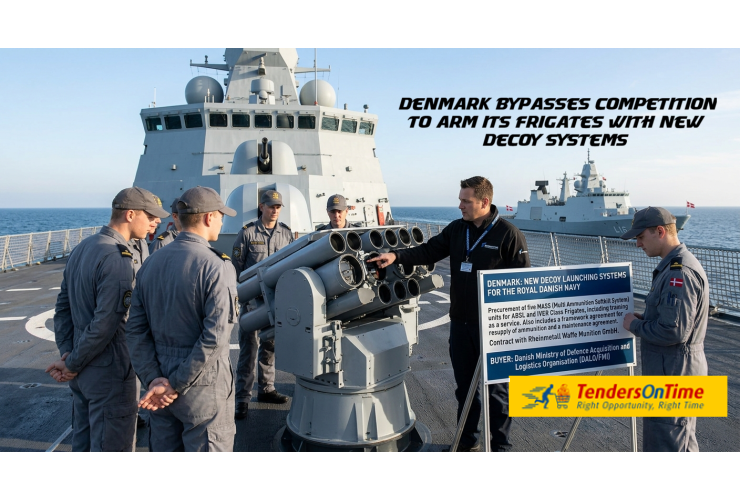
Denmark's Ministry of Defence Acquisition and Logistics Organisation has directly awarded Rheinmetall Waffe Munition GmbH a contract for a new Decoy Launching System for the Royal Danish Navy's frigates, alongside a maintenance and ammunition resupply framework worth up to DKK 1 275 000 000 over 20 years. The buyer bypassed competitive tendering entirely, citing a security situation in which, in its own words, Denmark is "no longer in peacetime."
Warships defend themselves against incoming missiles with more than armour and interceptors. Decoy launching systems fire clouds of chaff, flares or other countermeasures designed to confuse an incoming weapon's guidance system, buying a ship precious seconds. The Royal Danish Navy is now replacing this capability across its frontline frigates and it did so without running a competitive tender at all.
Forsvarsministeriets Materiel- og Indkøbsstyrelse, Denmark's defence procurement agency known as FMI, awarded the contract directly to Rheinmetall Waffe Munition GmbH, part of the German defence group Rheinmetall, under a European Treaty provision that lets member states bypass normal procurement competition when essential national security interests are at stake. The justification FMI put on the public record is unusually direct for a government procurement document.
FMI's own justification for skipping competitive tendering states plainly that the acquisition is essential because of the current security policy situation, in which Denmark is no longer in peacetime and that fielding a new Decoy Launching System lets Denmark join an already existing strategic cooperation with allied nations, gaining the data foundation needed to ensure the system's protective capability and, in turn, Denmark's essential national security interests. That is a striking level of candour for a public procurement notice and it reflects how directly European defence ministries are now tying individual equipment contracts to the continent's broader security deterioration.
The contract also illustrates how alliance interoperability increasingly shapes what equipment a country like Denmark can realistically choose. FMI states explicitly that only Rheinmetall Waffe Munition GmbH can meet Denmark's security needs here, both because of an existing allied strategic cooperation the system connects to and because supporting and maintaining a system like this over its lifetime requires manufacturer specific design knowledge that only the original supplier holds.
FMI has contracted with Rheinmetall Waffe Munition GmbH for five new Decoy Launching Systems, to be fitted to Royal Danish Navy frigates of the Absalon and Iver Huitfeldt classes, with the supplier also providing training as part of the acquisition. Alongside the equipment purchase, FMI has concluded a framework agreement covering ammunition resupply and system maintenance, running for an ordinary term of 7 years with options to extend by a further 7, then 3, then 3 years, for a maximum possible term of 20 years.
The procedure used was negotiated without prior call for competition, a direct award route. Only one tender was received, from the sole invited supplier and no ranking was applied since there was no competing bid to rank against.
| Contracting authority | Forsvarsministeriets Materiel- og Indkøbsstyrelse (FMI) |
| Contract title | Procurement of new Decoy Launching System for the Navy |
| CPV codes | 50240000, Repair, maintenance and associated services related to marine and other equipment, plus codes covering defence equipment and naval ammunition |
| Procedure type | Negotiated without prior call for competition, a direct award |
| Legal basis for direct award | Article 346(1)(b) of the Treaty on the Functioning of the European Union, defence and security specific exclusion |
| Estimated (approximate) value | DKK 745 000 000 |
| Maximum framework value | DKK 1 275 000 000 |
| Systems acquired | 5 Decoy Launching Systems, for Absalon and Iver Huitfeldt class frigates |
| Framework term | 7 years ordinary term, extendable to a maximum of 20 years |
| Place of performance | Primarily Korsør and Frederikshavn, Denmark |
| Award criteria | Price, 100 percent, selected for systematic reasons given the direct award |
| Tenders received | 1, submitted electronically |
| Winner | Rheinmetall Waffe Munition GmbH |
| Winner size classification | Large enterprise |
| Winner selected | 23 June 2025 |
| Contract signed | 18 June 2026 |
| EU funding | No |
| Framework structure | Framework agreement without reopening of competition, usable by all Danish Defence units |
| Subcontracting | No |
| Review body | Klagenævnet for Udbud (Danish Complaints Board for Public Procurement) |
| Notice reference | 545234 2026, OJ S 150/2026, published 6 August 2026 |
The contract covers five Decoy Launching Systems fitted to Royal Danish Navy frigates of the Absalon and Iver Huitfeldt classes, Denmark's principal air defence and flexible support frigates. The supplier delivers training as part of the acquisition itself. Separately, FMI has concluded a framework agreement with the same supplier covering ongoing maintenance, technical support, spare parts and resupply of ammunition for the system, running for up to 20 years, structured so that any unit under the Danish Ministry of Defence, not only the Navy, may draw on the agreement's terms.
FMI states it deliberately does not disclose how the framework's value splits between maintenance costs and ammunition resupply costs, explaining that revealing Denmark's expected ammunition stockpile levels could constitute a security risk. That is a candid and reasonable operational security rationale, though it does mean the public record cannot show how much of this contract's ultimate spending will go toward hardware support versus munitions.
Forsvarsministeriets Materiel- og Indkøbsstyrelse, known in English as the Danish Ministry of Defence Acquisition and Logistics Organisation, is based in Ballerup and classified as a central government authority and contracting entity active in defence. FMI is Denmark's central body for defence equipment acquisition, responsible for major procurement decisions across the Danish Armed Forces.
Forsvarsministeriets Materiel- og Indkøbsstyrelse
As covered above, FMI is the buyer for this contract and is also the organisation that signed the resulting agreement with Rheinmetall Waffe Munition GmbH.
Klagenævnet for Udbud
The Danish Complaints Board for Public Procurement, based in Viborg, is named as the review organisation. The notice sets out a detailed statutory review pathway: because FMI followed the procedure for voluntary prior transparency under Danish complaints board law, a complaint alleging an unlawful direct award must be filed within 30 calendar days of FMI's publication of this contract conclusion notice, provided the notice states the justification for awarding without prior competition, which it does. The Danish Competition and Consumer Authority is separately named as the body providing further information on review procedures.
Rheinmetall Waffe Munition GmbH
Rheinmetall Waffe Munition GmbH, based in Schneizlreuth, Germany, through its Buck Fronau branch, is the winning supplier and is classified as a large enterprise. The company is part of Rheinmetall, one of Europe's largest defence and automotive technology groups, publicly listed in Germany and a major supplier of weapons systems, ammunition and military vehicles to NATO militaries. Notably, FMI's own notice clarifies a naming correction: an earlier voluntary transparency notice for this contract named a related entity, Rheinmetall Protection Systems GmbH, as the supplier, but FMI states Rheinmetall Waffe Munition GmbH is the actual contracting party, with both companies structured under the same parent company. FMI assesses that this correction satisfies the relevant provision of Danish complaints board law governing such notices.
This contract was not competitively tendered. FMI used a negotiated procedure without prior call for competition, justified under Article 346(1)(b) of the Treaty on the Functioning of the European Union, the provision permitting EU member states to exclude normal procurement rules for contracts connected to the production of or trade in arms, munitions and war material, where necessary to protect essential national security interests. FMI's stated justification combines two distinct arguments: first, that fielding this specific system lets Denmark join an existing allied strategic cooperation and access data critical to the system's protective performance and second, that only the original manufacturer can safely maintain, support and supply ammunition for the system over its operational life, given the specialised design knowledge required and the ammunition's specific compatibility with the launcher.
Because this was a direct award, the price criterion recorded in the notice is described candidly as selected for systematic reasons rather than reflecting genuine competitive evaluation, since only one supplier was ever going to be considered. This transparency about the criterion's real function is a small but meaningful detail that helps readers correctly interpret what would otherwise look like a standard competitive procurement field.
The value range in this notice, DKK 745 000 000 estimated against a DKK 1 275 000 000 maximum, is unusually well explained by the buyer. FMI states clearly that the estimated figure represents its best current assessment of likely spending, while the maximum represents the full possible draw on the framework across its term, with the gap between them driven by genuine uncertainty over future operational needs, potential mission deployments, shifting resource allocation amid the evolving geopolitical situation and currency or price fluctuations over a term that could run two decades. This is a considerably more transparent explanation than many comparable defence notices offer for similar value gaps.
Naval self protection systems, including decoy launchers, sit in a narrow segment of the defence market where interoperability with allied systems and manufacturer specific lifecycle support create strong incumbency effects. Once a navy selects a decoy system tied into a broader allied strategic cooperation, as Denmark describes here, switching suppliers later becomes operationally and technically difficult, reinforcing the original manufacturer's position for decades of subsequent maintenance and ammunition supply.
Rheinmetall's position as the chosen supplier reflects its broader standing as one of the primary beneficiaries of Europe's post 2022 defence spending increases, with naval systems representing one more line of business alongside its better known land systems and ammunition production expansion across the continent.
At an estimated DKK 745 000 000, rising to a possible DKK 1 275 000 000 over a term that could run 20 years, this is a substantial long term commitment for the Royal Danish Navy, securing both new hardware and multi decade sustainment for a defensive capability the buyer has explicitly tied to core national security interests. The scale and duration reflect how naval self protection systems function less as one time purchases than as long running institutional relationships between a navy and its chosen supplier.
With the maintenance and resupply framework structured to extend in stages, 7 years, then a further 7, then two additional 3 year periods, FMI retains multiple decision points to review the arrangement without committing to the full 20 year term upfront. Given the framework's open availability to all Danish Defence units, further call offs beyond the five systems already contracted are plausible as Denmark's naval requirements evolve.
Because this contract was awarded directly under a national security exclusion, it offers limited direct opportunity for competing suppliers during its term. The more relevant signal for the broader defence market is how explicitly Denmark has now tied its equipment choices to allied interoperability, suggesting that naval and defence technology suppliers hoping to compete for future Danish contracts should prioritise demonstrable integration with existing NATO and allied systems architecture over standalone product merit.
This notice is a rare instance of a European defence procurement document stating its strategic rationale in genuinely direct language. FMI's explicit reference to no longer being in peacetime, offered as the operative justification for bypassing competitive tendering, reflects how far the language of European defence procurement has shifted since 2022, from routine capability planning toward openly acknowledged deterrence and readiness against a active and immediate security threat.
The value transparency in this notice also deserves recognition. Rather than leaving a large gap between estimated and maximum framework values unexplained, as several comparable notices across Europe do, FMI lays out precisely why the range exists and why finer detail cannot responsibly be published. Contracting authorities elsewhere in the EU tendering complex, multi year defence and security contracts could usefully take note of this approach, since it gives suppliers and the public a genuinely informative account without compromising the operational security considerations that make such contracts sensitive in the first place.
Strategically, this award reinforces how thoroughly alliance interoperability now shapes even individual national procurement decisions. Denmark's stated need to join an existing strategic cooperation with allied nations through this specific system is a reminder that in the current security environment, defence equipment choices are as much about coalition compatibility as they are about a single system's own technical merit, a dynamic likely to keep shaping which suppliers win sole source defence contracts across Europe in the years ahead.
Denmark's decision to arm its frigates with a new decoy system and to say so this plainly in a public procurement notice, captures where European defence policy now stands. This is not a routine equipment refresh dressed in technical language, but a security ministry stating outright that peacetime assumptions no longer apply and structuring a two decade supplier relationship accordingly. For Rheinmetall, it is another long term foothold in a European defence market moving with unusual openness about why it is spending what it is spending and on whom.
Source: Tenders Electronic Daily (TED), Contract Award Notice 545234-2026, Official Journal of the European Union, OJ S 150/2026, published on 6 August 2026.
Q1. Who is the buyer behind the naval decoy launching system contract under TED Notice 545234-2026 in Denmark?
The contracting authority is the Danish Ministry of Defence Acquisition and Logistics Organisation (Forsvarsministeriets Materiel- og Indkøbsstyrelse - FMI / DALO), based in Ballerup, Denmark, as reported on Tendersontime.
Q2. What military equipment procurement is covered under TED Notice 545234-2026 for the Royal Danish Navy?
The contract (Anskaffelse af nyt Decoy Launching System til Søværnet) covers the acquisition, repair, maintenance, and integration of new Decoy Launching Systems to outfit Royal Danish Navy (Søværnet) frigates with anti-missile countermeasure capabilities.
Q3. Where can I access the full procurement analysis on Denmark bypassing competitive bidding for frigate decoy systems?
A detailed analysis detailing Denmark’s single-source procurement, naval defense context, contractor selection, and fleet readiness strategy is available on Tendersontime.com.
Q4. Why did the Danish Ministry of Defence bypass competitive tender procedures for TED Notice 545234-2026 in Denmark?
The procurement was conducted via a Negotiated procedure without prior call for competition due to technical incompatibility risks, urgency in upgrading Baltic Sea naval defense, and protecting essential Danish national security interests.
Q5. When was the contract result notice officially published on the EU TED portal under TED Notice 545234-2026 in Denmark?
The official award result notice was published in the Supplement to the Official Journal of the European Union (OJ S 150/2026) under notice 545234-2026 on August 6, 2026.
Q6. Where will the naval decoy launching systems be deployed and integrated in Denmark?
The equipment will be integrated into active Royal Danish Navy frigates operating from naval bases in Denmark (NUTS 3 code: DK012 - Københavns omegn / Ballerup).
Q7. What role do Decoy Launching Systems play in defending Royal Danish Navy frigates under TED Notice 545234-2026 in Denmark??
Decoy Launching Systems deploy radio-frequency (chaff) and infrared countermeasures to mislead incoming anti-ship missiles, protecting naval vessels during combat and high-risk maritime operations.
Q8. What legal framework authorized Denmark's direct defense procurement under TED Notice 545234-2026 in Denmark?
The direct award was executed under European Union Defense Procurement Directive 2009/81/EC (Article 28 / Article 31 safety and technical compatibility exemptions) and applicable Danish defense procurement laws.
Q9. How does this decoy system acquisition reflect Denmark’s shifting defense posture in northern Europe?
Rapidly arming Danish frigates with specialized decoy launchers reflects Denmark's expanded naval readiness strategy across the Baltic Sea and North Atlantic amid evolving geopolitical security challenges.
Q10. How can defense contractors and naval equipment suppliers track military procurement tenders in Denmark?
Naval contractors, defense equipment manufacturers, and maritime suppliers can monitor Danish Armed Forces tender calls, sole-source announcements, and contract award notices via Tendersontime.com and the official TED portal.
 Sign in with Google