Login
Register
Complete Your Profile
Change Password
Request a Password Reset
Download Documents
Download Documents
Get Help to Participate in This Tender
Change Password
For better security, update the account password.
07 Jul 2026| Posted by John | In Other Services
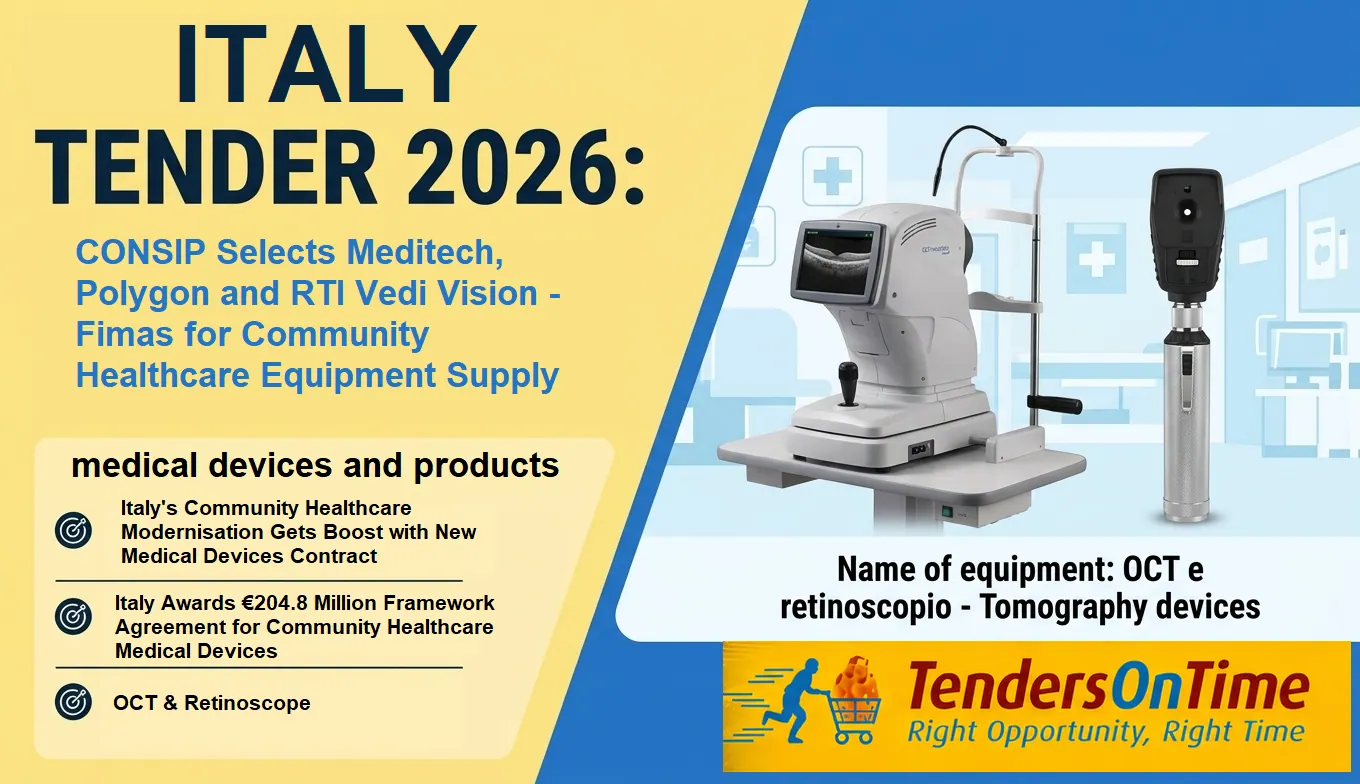
Italy's central purchasing body, CONSIP, has awarded a framework agreement worth up to €204.8 million for optical imaging equipment destined for the country's new "Case della Comunità", community health houses built with European recovery funds. Three Italian suppliers, Meditech S.r.l., POLYGON S.P.A. and a partnership between Vedi Vision Srl and Fimas Srl, will share the work. The award is one lot in an eleven lot programme worth close to €700 million and it offers a preview of how Italy intends to keep buying medical technology for years to come.
Walk into a newly opened community health centre in a mid sized Italian town today and there is a reasonable chance the eye imaging equipment on the ground floor did not exist there eighteen months ago. Italy is in the middle of rebuilding the front line of its public health system, financed largely by money borrowed collectively through the European Union's post pandemic recovery plan.
That rebuilding effort needs more than architects and construction crews. It needs diagnostic machines and someone has to buy them, at scale, for hundreds of sites at once. This notice is a window into exactly how that buying happens.
Public hospitals buy equipment site by site. Italy has chosen a different model for its community care reform: one national buyer, CONSIP, purchasing on behalf of every public administration in the country through framework agreements.
That single decision changes the economics of the entire medical devices market in Italy. A supplier that wins a lot here does not sell to one clinic. It gains a standing route to sell into a pipeline of health facilities being rolled out nationwide over several years.
For citizens, the contract matters because it determines whether community clinics can actually deliver the diagnostic services they were promised, rather than becoming empty buildings with no equipment inside.
The contracting authority has not disclosed the operational start date for call offs under the framework, nor the framework's total duration in months or years.
CONSIP ran an open, EU wide tender divided into eleven separate lots, each covering a different category of medical device destined for Case della Comunità and related "proximity" health facilities, smaller units built close to where people live, rather than centralised in large hospitals.
This notice concerns Lot 6, covering optical coherence tomography (OCT) scanners and retinoscopes, devices used to examine the retina and assess vision, core tools for community level eye care. The lot calls for 2,860 units and carries a maximum framework value of €204,787,440.
Because it is a framework agreement "without reopening of competition," public bodies across Italy can draw down equipment directly from the three winning suppliers over the life of the agreement, without running a fresh mini tender each time. That is a materially faster route to market than a traditional one off contract.
| Detail | Information |
|---|---|
| Contracting authority | CONSIP S.p.A. (Rome, Italy) |
| Procedure title | Framework agreement for technological equipment for Case della Comunità and proximity facilities (ID 2802) |
| Lot covered by this notice | Lot 6, OCT devices and retinoscopes (ophthalmic diagnostic imaging) |
| Units to be supplied under Lot 6 | 2,860 |
| Maximum value of Lot 6 framework | €204,787,440 (excl. VAT) |
| Estimated value of the entire 11 lot programme | €695,563,440 (excl. VAT) |
| Procurement procedure | Open procedure |
| Framework agreement type | Framework agreement without reopening of competition, multiple suppliers |
| Award criterion | Lowest price |
| Tenders received for Lot 6 | 4 |
| Winning suppliers (Lot 6) | Meditech S.r.l.; POLYGON S.P.A.; RTI Vedi Vision Srl – Fimas Srl |
| Legal basis | Directive 2014/24/EU; Italian Public Contracts Code (D.Lgs. 36/2023) |
| Covered by the WTO Government Procurement Agreement | Yes |
| EU funding | Yes, project financed wholly or partly by EU funds |
| Review body | Regional Administrative Court for Lazio (TAR Lazio), Rome |
| Contract duration | The contracting authority has not disclosed this information |
The wider programme, running to eleven lots, is designed to equip Case della Comunità and other proximity health structures with a broad basket of diagnostic devices: dermatoscopes, 12 lead electrocardiographs, emergency cart defibrillator monitors, spirometers, ultrasound scanners and four categories of point of care testing analysers covering blood chemistry, haematology, coagulation and immunochemistry, in addition to the OCT scanners and retinoscopes covered by Lot 6.
Lot 6's equipment is specifically clinical eye care technology. An OCT scanner uses light waves to produce cross sectional images of the retina, similar in principle to an ultrasound but using light instead of sound and it is standard equipment for detecting conditions such as glaucoma, diabetic retinopathy and macular degeneration. A retinoscope is a simpler handheld instrument used to assess a patient's refractive error, essentially, how well their eyes focus light, without the patient needing to respond verbally, which makes it useful for testing children and patients who cannot communicate clearly.
Bringing this kind of equipment into neighbourhood clinics, rather than keeping it confined to hospital ophthalmology departments, is intended to let more patients get eye conditions screened and diagnosed closer to home.
CONSIP S.p.A. is Italy's national central purchasing body, wholly owned by the Ministry of Economy and Finance. It does not use hospitals or clinics as end clients directly; instead, it runs procurement procedures on behalf of the wider Italian public administration and lets individual public bodies draw supplies and services from the frameworks and catalogues it establishes.
CONSIP is classified in the notice as a "body governed by public law" carrying out "general public services" activity, standard classifications for a state owned procurement agency rather than a operational health authority. Its role here is that of buyer of record, running the tender, evaluating bids and awarding the framework agreements that public administrations will subsequently use.
For anyone trying to sell medical technology into Italy's public sector, CONSIP is usually the gatekeeper, not the individual hospital or clinic.
CONSIP S.p.A., Buyer / Central Purchasing Body
CONSIP is the organisation that structured, launched and awarded this procedure. It is based in Rome and operates the digital procurement platform used to run the tender, Acquisti in Rete PA. Its role is to aggregate demand from public bodies across Italy into large, centrally negotiated framework agreements, which typically secures lower unit prices than hundreds of individual hospitals negotiating separately.
Tribunale Amministrativo Regionale per il Lazio – Roma, Review Organisation
This is the Regional Administrative Court for Lazio, based in Rome, Italy's standard forum for challenging public procurement decisions taken by national authorities. Any supplier that believes the award was conducted unfairly has 30 days from the notice's publication in Italy's national public contracts database to lodge an appeal there. Its presence in the notice is procedural rather than commercial: it exists to police the fairness of the award, not to participate in it.
Meditech S.r.l., Winning Supplier, Lot 6
Meditech S.r.l. is based in Gallarate, in the Varese area of Lombardy. It was named a winning tenderer for Lot 6 with a bid valued at €101,590,632. The notice confirms Meditech intends to use subcontractors but does not disclose the value or percentage of work being subcontracted. Meditech's position as the lowest bidder among the three winners under a lowest price award criterion indicates it offered the most competitive unit pricing for OCT and retinoscope supply in this lot.
POLYGON S.P.A., Winning Supplier, Lot 6
POLYGON S.P.A. is based in Rome. It was named a winning tenderer for Lot 6 with a bid valued at €168,380,784. The company disclosed that 40% of the contract value will be subcontracted, a meaningfully higher subcontracting share than its co winners, suggesting POLYGON is likely coordinating a wider supply and service network to deliver its share of the framework rather than manufacturing and distributing entirely in house.
RTI Vedi Vision Srl - Fimas Srl, Winning Supplier
This is a temporary business grouping, known in Italy as a Raggruppamento Temporaneo di Imprese or RTI, the local equivalent of a joint venture bidding consortium, formed between Vedi Vision Srl and Fimas Srl, both based in the Venice area. The grouping submitted the highest of the three winning bids, valued at €204,787,440, matching the maximum ceiling value recorded for the Lot 6 framework agreement in this notice. The notice discloses that 6% of the contract will be subcontracted. The contracting authority has not disclosed which of the two partner companies leads the consortium or how responsibilities are divided between them.
CONSIP ran this as an open procedure under Article 71 of Italy's 2023 Public Contracts Code, meaning any qualified economic operator could submit a bid, with no preselection or invitation stage. Open procedures are the default choice for standardised, well understood goods like medical devices, where restricting the field to prequalified bidders would add time without a clear benefit.
The award criterion was price alone. CONSIP did not score bids on technical quality, delivery speed or service levels, it selected the lowest compliant bids up to the point needed to fill the framework. Price only awards are common for CPV classified commodity medical equipment where the underlying technical specification is fixed in the tender documents, so competition is pushed entirely into the price the supplier is willing to accept.
The framework agreement is structured without reopening of competition. That means, once a public hospital or clinic needs OCT equipment, it can order directly against the agreed terms and pricing from one of the three ranked winners without CONSIP or the buying body running a further competitive round. This significantly speeds up how fast individual Case della Comunità can actually receive and install equipment, compared with each site tendering separately.
Only four tenders were received for Lot 6, a relatively narrow field for a contract of this size, which likely reflects both the technical specificity of ophthalmic imaging equipment and the scale required to service a framework potentially worth over €200 million.
The contract is confirmed as funded wholly or partly by EU money and is covered by the WTO Government Procurement Agreement (GPA), meaning qualified suppliers from GPA signatory countries outside the EU were also entitled to bid on equal terms.
The wider ID 2802 programme allows a single bidder to compete for all eleven lots simultaneously, there is no cap restricting how many lots one company can pursue, which explains why some winners in this and other lots may hold positions across multiple product categories in the same programme.
The overall estimated value of the full eleven lot tender is €695,563,440 excluding VAT, against a base tender price (before contractual options) of €445,874,000. Across all eleven lots, CONSIP set a combined ceiling of 28,600 devices, ranging from 1,430 units in the smallest lots to 4,290 units in the largest.
The legal basis cited is EU Directive 2014/24/EU alongside Italy's domestic implementing legislation, Legislative Decree 36/2023. Bidders were required to lodge both a provisional guarantee and a final performance guarantee, standard safeguards in Italian public contracts designed to protect the buyer if a winning supplier fails to perform.
For Italy's medical devices sector, this notice confirms something suppliers have suspected since the recovery plan's health investments were first announced: CONSIP, not individual hospitals, is now the primary customer for community level diagnostic equipment.
That concentration of demand favours suppliers with strong national distribution and service networks over smaller regional players. Both POLYGON and the Vedi Vision–Fimas grouping disclosed meaningful subcontracting shares, an indicator that even winners are building coalitions of manufacturers, distributors, installers and maintenance providers rather than fulfilling the contract entirely alone.
The ophthalmic imaging segment specifically benefits from a policy push to catch eye disease earlier, closer to where patients live, rather than waiting for hospital referral. That should support sustained demand for OCT and retinoscopy equipment well beyond this single framework, as more Case della Comunità become operational and need to be fitted out to the same specification.
Public health infrastructure spending of this size acts as a demand signal well beyond the immediate winners. A framework worth up to €695 million across eleven lots for a single procurement programme is large by any European public procurement standard and it is only one strand of Italy's wider health investment financed through the EU's recovery instrument, which allocates billions of euros to community healthcare and hospital modernisation.
For the domestic medical technology supply chain, manufacturers, importers, installers and maintenance firms, programmes like this represent multi year revenue visibility that is unusual in a sector more often characterised by fragmented, one off hospital tenders. That visibility matters for investment decisions: companies can justify expanding production, hiring technicians or building service networks when a national contract, rather than a single hospital order, is backing the demand.
Framework agreements of this kind are rarely one off events. As Italy's community health house rollout continues, regional health authorities are still activating new sites toward national targets set under the recovery plan, demand for equipment against this framework and future ones like it should continue for as long as the framework remains active.
Suppliers who did not win Lot 6 should watch for CONSIP's future retenders once framework ceilings are exhausted or expiry approaches and should also monitor the other ten lots in the same ID 2802 programme, several of which cover adjacent diagnostic categories such as ultrasound, ECG and point of care testing devices that often sit in the same clinical spaces as OCT and retinoscopy equipment.
Watch how quickly individual Case della Comunità actually draw down equipment against this framework. Italy's recovery plan health targets have faced delivery delays before and a framework agreement only translates into real orders once regional health authorities have facilities ready to receive the equipment.
Watch CONSIP's publication calendar for the remaining lots in programme ID 2802 that have not yet reached award stage and for any future retenders once this framework's ceiling values are approached.
Watch the review timeline. Unsuccessful bidders in Lot 6 have thirty days from publication to challenge the award before Italy's Regional Administrative Court for Lazio; a challenge, if lodged, could affect how quickly call offs begin.
This award is a useful case study in how EU recovery plan spending is reshaping the shape of national procurement itself, not just the buildings it funds. Italy did not simply hand regional health authorities a budget and let each one buy equipment independently. It centralised purchasing through CONSIP and prenegotiated multi supplier frameworks, which trades some local flexibility for speed, price leverage and consistency of specification across hundreds of sites.
That is a deliberate strategic choice and it is one other EU governments spending recovery plan money on healthcare infrastructure are likely to study closely. Centralised, multi winner frameworks without reopened competition are faster to operationalise than repeated local tenders, but they concentrate market access into the hands of a small number of national scale suppliers per product category, in this case, three companies now control the entire OCT and retinoscope supply route for Italy's community health programme.
Suppliers responding to this trend should treat national framework wins not as a single sale but as a distribution licence: the real commercial opportunity lies in being able to service, maintain and resupply equipment across a dispersed national network for the life of the agreement, not merely in the initial unit price submitted at tender. Expect future Italian health procurement and similar EU funded programmes elsewhere to keep favouring this centralised model as governments try to convert recovery plan money into working clinics on tight EU set deadlines.
A single lot inside a national procurement programme rarely tells the whole story on its own, but this one is a clear marker of where Italy's public health spending is heading: fewer, larger, centrally run contracts that convert EU recovery money into standing supply relationships rather than one off purchases. For the three companies now holding this framework, the real test starts now, delivering equipment to hundreds of dispersed sites, on schedule, under a contract structure built for speed rather than local negotiation.
What is a Casa della Comunità?
It is a new type of Italian public health facility, funded largely through the EU's post pandemic recovery plan, designed to bring primary and basic diagnostic care physically closer to local communities rather than concentrating it in hospitals.
Who is CONSIP and why does it run this tender instead of individual hospitals?
CONSIP is Italy's national central purchasing body, owned by the Ministry of Economy and Finance. It runs large framework agreements on behalf of public administrations nationwide, aiming to secure better pricing and consistent specifications than hundreds of separate local tenders could achieve.
Why were there three winners for one lot?
The framework agreement was structured to be "without reopening of competition" with multiple suppliers, ranked by price. This lets public buyers place orders directly against pre agreed terms with any of the three, rather than negotiating fresh terms for every purchase.
What equipment does Lot 6 actually cover?
Optical coherence tomography (OCT) scanners, which produce detailed images of the retina to help detect eye conditions and retinoscopes, handheld instruments used to test how well a patient's eyes focus light.
How much is the contract worth?
Lot 6 alone carries a maximum framework value of €204,787,440. It sits within a wider eleven lot programme estimated at €695,563,440 in total.
Can other lots in this programme still be won by new suppliers?
The remaining ten lots in the same procurement programme (ID 2802) cover other device categories, including ultrasound, ECG and point of care testing equipment. Award status for those lots is not covered by this notice.
Is this contract open to non EU suppliers?
Yes. The tender is confirmed as covered by the WTO Government Procurement Agreement, meaning qualified suppliers from GPA member countries outside the EU were entitled to bid on equal terms.
How long does the framework agreement last?
The contracting authority has not disclosed this information in the notice.
Source: EU Official Journal, Contract Award Notice 466566 2026, OJ S 128/2026, published 7 July 2026. Contracting authority: CONSIP S.p.A.
 Sign in with Google