
Login
Register
Complete Your Profile
Change Password
Request a Password Reset
Download Documents
Download Documents
Get Help to Participate in This Tender
Change Password
For better security, update the account password.
Home » Blog » Defence and Security
02 Oct 2026| Posted by John | In Defence and Security
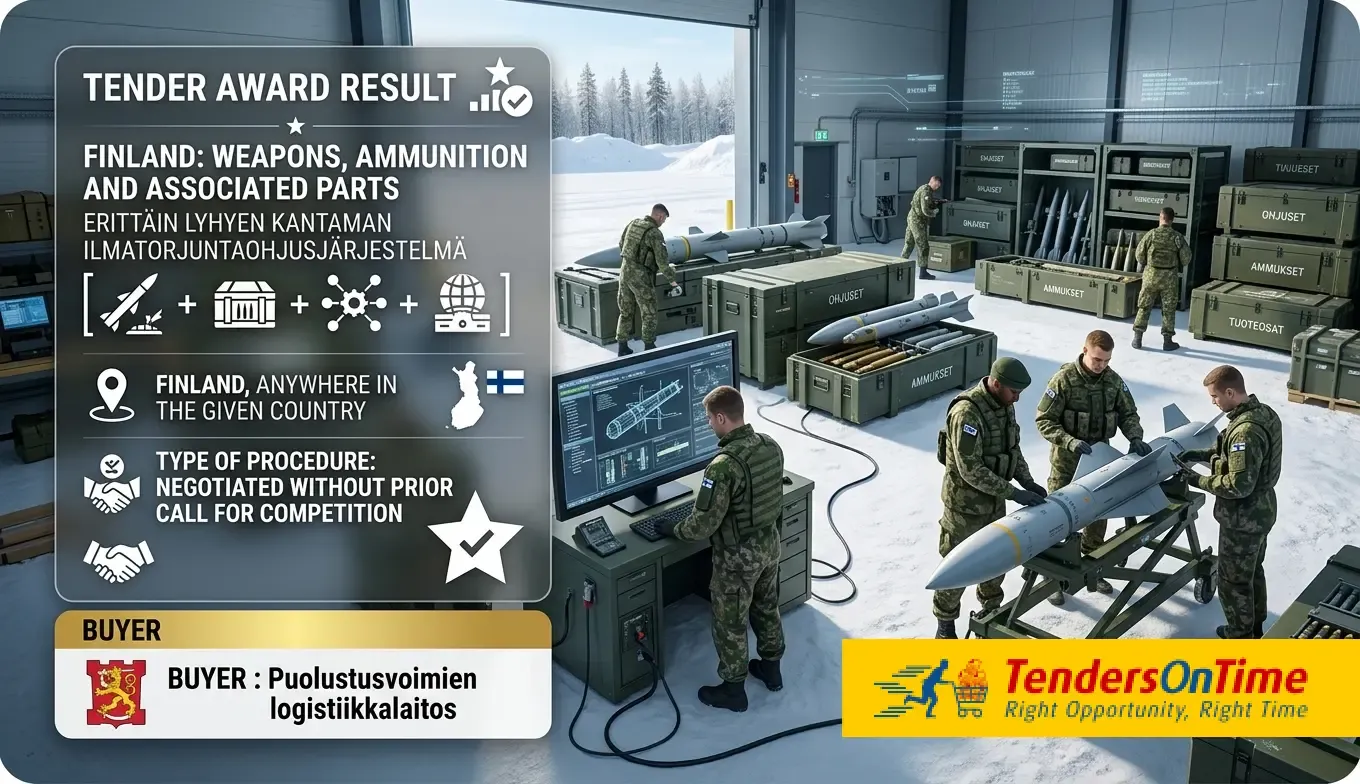
Finland's Defence Forces Logistics Command has awarded a contract to Saab Dynamics AB for very short-range air defence missile system launchers. The contract, valued at SEK 1,165,683,100, covers RBS 70 NG firing units, training materials, spare parts and special tools. It was awarded without a call for competition, on the grounds that only Saab can supply equipment technically compatible with Finland's existing RBS 70 launchers and Bolide missiles. The contract runs for eight years, starting on 1 September 2026.
Air defence is one of the least visible and most technically demanding parts of a country's military capability. Very short-range air defence systems, known in military shorthand as VSHORAD, are designed to engage low-flying aircraft, helicopters and drones at close range. They are often the last line of protection for ground units, airfields and critical infrastructure.
Finland, which shares a long border with Russia, has invested steadily in air defence since the end of the Cold War. Its armed forces operate a mix of systems, including the Saab RBS 70 family of man-portable and platform-mounted missile launchers. The RBS 70 is a Swedish-designed system that uses laser beam-riding guidance, which makes it resistant to many common countermeasures.
Finland's Defence Forces Logistics Command has now awarded a contract to Saab Dynamics AB for the latest generation of that system: the RBS 70 NG, or New Generation. The contract is a direct award, made without a call for competition, and it is justified on technical compatibility grounds. It is a significant procurement, both in value and in what it reveals about how defence buyers handle the problem of maintaining legacy systems while upgrading them.
This contract matters because it is a direct award, not a competitive tender. Direct awards are exceptional in EU procurement, and they are permitted only in narrowly defined circumstances. In this case, the Finnish authority has justified the direct award on technical grounds: only Saab Dynamics AB's products are compatible with Finland's existing RBS 70 launchers and its stock of Bolide missiles.
That justification is detailed and specific. The authority explains that missile systems integrate launchers and missiles mechanically and electrically, including information flow, control traffic, software and operating logic. That integration is always manufacturer-specific. A missile from one manufacturer cannot be fired from another manufacturer's launcher unless the two have been developed jointly. The Bolide missiles in Finland's inventory are designed for the RBS 70 family, and only Saab launchers can fire them.
The contract also matters because of its value and duration. At SEK 1,165,683,100 over eight years, it is a major defence procurement. It shows that Finland is continuing to invest in its air defence capability, and that it is doing so by upgrading an existing system rather than replacing it entirely.
Finally, it matters because of what it says about the defence market. Very short-range air defence is a specialised segment with few suppliers. Saab is one of the dominant players in Europe. The direct award reflects a market reality: when a country has already invested in a particular system, its future procurement options are constrained by compatibility.
The contract covers the supply of Saab RBS 70 NG firing units and associated product support. The notice describes the procurement as including RBS 70 NG (New Generation) firing platforms, necessary training materials, spare parts and special tools.
It is a single-lot procurement, identified as LOT-0000, with the internal identifier 6658/2025. The contract identifier is 7783/2026, and the contract title is "VSHORAD FIN." The main nature of the contract is supplies, classified under CPV 35300000 (weapons, ammunition and associated parts).
The place of performance is Finland, anywhere in the country. The contract is not financed with EU funds. It is governed by Directive 2009/81/EC, the EU directive on defence and security procurement, rather than the general public sector directive.
The contract value is SEK 1,165,683,100. The notice does not state whether this is the value of the winning tender only or the total value of all contracts awarded under the notice. In this case, since there is only one contract and one winner, the two figures coincide.
| Notice ID | 680588-2026 |
| OJ S issue | 191/2026 |
| Publication date | 2 October 2026 |
| Contracting authority | Puolustusvoimien logistiikkalaitos (Finnish Defence Forces Logistics Command) |
| Contract type | Supplies |
| Main CPV code | 35300000 – Weapons, ammunition and associated parts |
| Procedure type | Negotiated without prior call for competition (direct award) |
| Legal basis | Directive 2009/81/EC |
| Lot | LOT-0000 |
| Winner | Saab Dynamics AB |
| Contract value | SEK 1,165,683,100 |
| Number of tenders | 1 |
| Award criterion | Total procurement cost (fixed value) |
| Contract duration | 8 years |
| Start date | 1 September 2026 |
| Framework agreement | No |
| EU funding | No |
| Subcontracting | Not yet known |
| Contract identifier | 7783/2026 |
| Contract title | VSHORAD FIN |
The scope is the supply of Saab RBS 70 NG firing units and associated product support. The notice describes the procurement as covering the RBS 70 NG (New Generation) firing platforms, necessary training materials, spare parts and special tools.
The RBS 70 NG is the latest version of Saab's RBS 70 short-range air defence system. It is designed to engage aerial targets at very short range, using laser beam-riding guidance. The "NG" designation indicates improvements over earlier versions, typically in sights, night capability, automation and target tracking.
The contract includes "product support" elements, which in defence procurement usually cover spare parts, training materials, technical documentation and special tools. These are essential for maintaining the system over its service life, and they are often negotiated as part of the initial acquisition.
The notice does not disclose the number of firing units being procured, the delivery schedule, the specific configuration of the RBS 70 NG, or the breakdown of the contract value between launchers, training materials, spare parts and tools. The contracting authority has not disclosed this information.
The buyer is the Puolustusvoimien logistiikkalaitos, the Finnish Defence Forces Logistics Command. It is classified as a central government authority with defence as its main activity. Its registration number is 0952029-9, and its address is Hatanpään valtatie 30, Tampere, postcode 33541, in the Pirkanmaa region.
The Logistics Command is responsible for procurement, maintenance and supply for the Finnish Defence Forces. It handles acquisitions across all branches of the military, from routine supplies to major equipment programmes. Its contact email for this procurement is [email protected].
The Logistics Command is both the buyer and the organisation signing the contract. It also acts as the point of contact for the procurement. The notice lists it under the Finnish Defence Forces website, puolustusvoimat.fi.
Puolustusvoimien logistiikkalaitos (Finnish Defence Forces Logistics Command)
The Logistics Command is the contracting authority. It is a central government authority responsible for defence procurement and logistics in Finland. Its role in this procurement is as buyer, signatory of the contract and point of contact for the procedure.
It is registered in Tampere, with registration number 0952029-9. Its contact point for this procurement is the Logistics Command's headquarters (esikunta). It operates under the Finnish Ministry of Defence and is responsible for acquiring and maintaining the equipment used by Finland's armed forces.
The Logistics Command's decision to use a direct award is central to understanding this procurement. It concluded that only Saab Dynamics AB could supply the required launchers, because of the technical integration between launchers and missiles in the RBS 70 system.
Saab Dynamics AB
Saab Dynamics AB is the winning supplier. It is a Swedish defence company based in Karlskoga, postcode 69180, in the Örebro län region. It is part of the Saab group, a Swedish defence and aerospace company.
Saab Dynamics is the manufacturer of the RBS 70 family of air defence systems and the Bolide missile. It submitted the only tender for LOT-0000, identified as tender 302050853, valued at SEK 1,165,683,100. The notice records its subcontracting status as "not yet known."
The company's role is as tenderer and winner of LOT-0000. It will supply the RBS 70 NG firing units, training materials, spare parts and special tools to the Finnish Defence Forces. The notice does not disclose whether other Saab entities or third parties will be involved in delivery. The contracting authority has not disclosed this information.
Markkinaoikeus (Market Court of Finland)
The Markkinaoikeus is Finland's Market Court, the judicial body that handles public procurement disputes. It is listed as the review organisation for this procurement. Its registration number is 3006157-6, and its address is Radanrakentajantie 5, Helsinki, postcode 00520.
Its role is to hear appeals from suppliers who believe a procurement has been conducted improperly. In defence procurement, the scope for review may be more limited than in civilian procurement, but the Market Court remains the designated review body.
Hansel Oy (Hilma)
Hansel Oy is a Finnish central purchasing body and the operator of Hilma, the Finnish national procurement notification service. It is listed as the TED eSender for this notice. Its role is administrative: it transmits the notice to Tenders Electronic Daily. It is registered in Helsinki, postcode 00100, with registration number FI09880841. It is not involved in the procurement decision itself.
Other organisations
The notice does not list any other tenderers, consortium members, framework participants or subcontractors. Only one tender was received, from Saab Dynamics AB. No other organisation materially affects the understanding of this award.
The procurement was conducted as a negotiated procedure without prior call for competition, commonly described as a direct award. This is an exceptional procedure under EU defence procurement rules, permitted only when specific conditions are met.
The Finnish authority has justified the direct award under Section 22, subsection 1, paragraph 3 of the Finnish Act on Defence and Security Procurement. That provision allows a contracting authority to choose a direct award if, for technical or exclusive rights reasons, only a particular supplier can carry out the procurement. The notice explains that the procurement must be technically compatible with the existing air defence missile system.
The justification is detailed. Only Saab Dynamics AB's products are mutually compatible, and only the RBS 70 NG launchers being procured can replace the ageing Saab RBS 70 launchers currently in service. Both systems are designed to be used with Bolide missiles, which Finland has in storage. If the system were replaced entirely with a different one, those missiles would become unusable.
The notice also explains that other air defence missiles are not mechanically or electrically compatible with the RBS 70 launcher family. Missile systems integrate launchers, missiles and their control systems mechanically and electrically, including information, control traffic, software and operating logic. This integration is always manufacturer-specific. A missile from one manufacturer cannot be fired from another manufacturer's launcher unless the products were developed jointly. The operation, performance and safety of the missile are part of that integration.
Saab Dynamics AB confirmed in a response to a Request for Information (RFI 301803687/JV2824, dated 21 June 2024) that the Bolide missiles in Finland's inventory are compatible with the RBS 70 NG launchers, and that those launchers are specifically designed for use with the Bolide missile. The response also confirmed that the launcher type being procured is compatible with the launcher type previously procured.
The selected supplier is the manufacturer of the Bolide missile and the RBS 70 launcher. Saab Dynamics AB owns the intellectual property rights to the products being procured, and there are no other licensed manufacturers. That means there are no other potential suppliers who could deliver these specific products.
The notice also describes the market consultation that preceded the direct award. A Request for Information was sent in 2024 to four suppliers, selected on the basis of a broader 2019 RFI and a subsequent mapping of existing systems. On the basis of the 2024 RFI, none of the other launchers on the market were compatible with Finland's existing launcher type and the Bolide missile.
The authority therefore concluded that the procurement could not be carried out under other procedures defined in the Act on Defence and Security Procurement, because only Saab Dynamics AB's products are technically compatible with existing systems.
Only one tender was received. The award criterion was total procurement cost, expressed as a fixed value. This means the authority evaluated the overall cost of the procurement rather than using a price-versus-quality weighting. In a direct award with a single supplier, the award criterion is less about comparing competing offers and more about establishing the basis on which the contract was concluded.
The contract is not a framework agreement. It is a direct contract with a single supplier. The notice does not disclose whether the contract includes options for additional purchases or follow-on support.
The very short-range air defence market is small and specialised. Few companies manufacture complete VSHORAD systems, and even fewer manufacture the missiles and launchers as an integrated package. Saab, through its RBS 70 family, is one of the established European suppliers. Others include MBDA, Thales and a handful of national champions.
The RBS 70 system has been in service for decades and has been sold to numerous countries. Its longevity is notable. The original RBS 70 entered service in the late 1970s, and Saab has continued to develop it through multiple generations. The RBS 70 NG is the current version, and it remains in production.
This contract reflects a common pattern in defence procurement: once a country has invested in a particular system, subsequent purchases are often constrained by compatibility. Missiles, launchers and fire control systems are tightly integrated. Switching to a different system means replacing not just the launchers but also the missiles and possibly the training, maintenance and logistics infrastructure. That makes direct awards for follow-on purchases relatively common in defence, even in countries that generally favour competition.
The Finnish authority's approach is notable for its transparency. The notice sets out the technical justification in detail, references the RFI process and explains why no alternative was available. That level of detail is not always present in direct award notices, and it provides a clear record of the reasoning behind the decision.
From a market perspective, the contract reinforces Saab's position in Finland and in the wider Nordic and Baltic region. Finland's decision to upgrade rather than replace its RBS 70 fleet is a signal that the system remains viable and that Saab can expect further support and upgrade work over the contract's eight-year term.
At SEK 1,165,683,100, this is a substantial defence contract. It is significant for Saab Dynamics AB, providing a multi-year revenue stream and reinforcing its position as a supplier to Finland. It is also significant for Finland's defence budget, representing a long-term commitment to air defence capability.
Defence procurement has economic effects that go beyond the contract value. It supports jobs in the supplier's home country, maintains industrial capability in a strategically important sector, and can generate follow-on work in maintenance, training and upgrades. For Saab, the contract supports employment at its Karlskoga facility and across its supply chain.
For Finland, the economic significance is different. The contract is a cost, not a revenue source. But it contributes to national security, which is a precondition for economic activity. A credible air defence capability deters aggression and protects the infrastructure on which the economy depends.
The contract also has a broader European dimension. Finland is an EU member state and a NATO member. Its defence procurement decisions affect the wider balance of capabilities in the Nordic and Baltic regions. The choice to upgrade the RBS 70 fleet rather than replace it with a different system maintains interoperability with other RBS 70 operators and preserves the value of Finland's existing missile inventory.
The most likely future opportunity is follow-on support for the RBS 70 NG system. Over an eight-year contract, there will be maintenance, spare parts, training and possibly upgrade work. The notice describes the current contract as including training materials, spare parts and special tools, but further support needs may arise as the system enters service.
There may also be opportunities related to the Bolide missile inventory. Finland has Bolide missiles in storage, and the RBS 70 NG launchers are designed to use them. If Finland decides to replenish or expand its missile stock, that would be a separate procurement, likely also directed to Saab.
More broadly, Finland's air defence modernisation is an ongoing process. The country has been investing in multiple layers of air defence, including longer-range systems. Future procurements may include additional VSHORAD units, upgrades to existing systems, or integration work with other air defence assets. Suppliers with compatible technologies may find opportunities, though the compatibility constraint will continue to favour Saab for RBS 70-related work.
Suppliers should monitor the Finnish Defence Forces' procurement notices through Hilma and TED for future opportunities. However, in the VSHORAD segment, the scope for non-Saab suppliers is limited by the installed base of RBS 70 equipment.
This contract is a clear example of a broader procurement reality in defence: technical compatibility constrains competition. When a country has already invested in a weapons system, its future procurement options are limited by the need to integrate with existing launchers, missiles, training and logistics. That constraint is recognised in EU defence procurement law, which permits direct awards on technical grounds. The Finnish authority has used that provision carefully, with a detailed justification and a documented market consultation.
The award is strategically important for several reasons. First, it shows that Finland is continuing to invest in very short-range air defence, a capability that has become more salient since 2022. Second, it reinforces Saab's position as a key supplier to Finland's armed forces. Third, it demonstrates how defence buyers manage the tension between competition and compatibility: they consult the market, document the results, and use the legal exceptions when genuine alternatives do not exist.
Suppliers can learn several things from this procurement. First, in defence, compatibility is a hard constraint. Suppliers that cannot demonstrate technical compatibility with an existing system will not be able to compete, regardless of price or quality. Second, intellectual property ownership matters. Saab owns the rights to the RBS 70 and Bolide, and there are no licensed alternative manufacturers. Third, market consultation matters. The Finnish authority sent an RFI to four suppliers before deciding on a direct award. That process gave it the evidence it needed to justify the direct award and to demonstrate that it had tested the market. Fourth, transparency matters. The notice sets out the technical justification in unusual detail, which reduces the risk of successful legal challenge.
Suppliers should position themselves accordingly. Those seeking to supply defence equipment need to understand the installed base of systems in their target markets and whether their products are compatible. Those seeking to challenge direct awards need to be able to show that a compatible alternative exists — which, in this case, no supplier could do. And those already inside a defence supply chain, such as Saab's, should watch for subcontracting and support opportunities as the contract moves into delivery.
Future contracts in this market are likely to evolve in two directions. First, countries with existing RBS 70 systems are likely to continue upgrading to the NG version, generating follow-on direct awards to Saab. Second, as drone threats grow, demand for VSHORAD systems is likely to increase across Europe, creating opportunities for Saab and its competitors. But in markets where RBS 70 is already installed, the compatibility constraint will continue to shape procurement outcomes. Suppliers outside that ecosystem will find it hard to break in, and buyers will continue to rely on direct awards where compatibility leaves no genuine alternative.
Finland has chosen to upgrade its very short-range air defence capability by buying the latest generation of a system it already operates. The contract, worth SEK 1,165,683,100 over eight years, goes to Saab Dynamics AB and covers RBS 70 NG launchers, training materials, spare parts and special tools. It was awarded without a call for competition, because only Saab's products are compatible with Finland's existing launchers and its stock of Bolide missiles.
The direct award is not a shortcut. It is the result of a detailed technical assessment and a market consultation that confirmed no compatible alternative exists. The notice sets out the reasoning in unusual detail, explaining the mechanical, electrical and software integration between launchers and missiles, and confirming that Saab owns the relevant intellectual property rights.
For suppliers, the contract is a reminder that in defence procurement, compatibility often trumps competition. For Finland, it is a step in maintaining a capability that has become more important in recent years. For Saab, it is a significant multi-year order that reinforces its position in the Nordic defence market. The contract will run until 2034, with follow-on support and possible missile replenishment likely to follow.
Source: Tenders Electronic Daily (TED), Contract Award Notice 680588-2026, Official Journal of the European Union, OJ S 191/2026, published on 2 October 2026.
 Sign in with Google