Login
Login
Register
Complete Your Profile
Change Password
Request a Password Reset
Download Documents
Download Documents
Get Help to Participate in This Tender
Change Password
For better security, update the account password.
10 Jul 2026| Posted by James | In Other Services
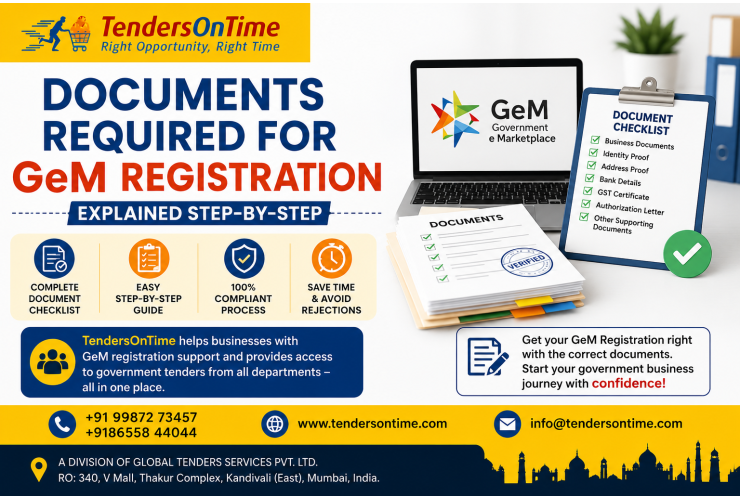
If you've decided to sell to government departments, PSUs, or municipal bodies in India, the first real hurdle isn't the selling part - it's the paperwork. Knowing the exact documents required for GeM registration before you sit down to fill the form saves you hours of back-and-forth, rejected uploads, and OTP fatigue.
We work with vendors across India every week - from first-time MSMEs to established suppliers expanding into government contracts - and the same question comes up almost every time: "What documents do I actually need, and in what format?" This guide answers that in plain language, based on how the process actually works today, not how it worked two years ago.
Whether you're doing it yourself or bringing in a GeM registration consultant, this checklist will make the process faster and far less confusing.
The GeM portal verifies your identity and business details against government databases in real time. If your PAN doesn't match your business name exactly, or your Aadhaar-linked mobile number is outdated, the system flags it instantly.
That's the part most people underestimate. It's not that the documents are hard to get - it's that small mismatches cause big delays. A misspelled firm name on a GST certificate versus your PAN card is a common, avoidable reason applications stall.
Here's the baseline list that applies to almost every applicant, regardless of business structure.
Your business PAN (or personal PAN, for proprietorships) is the anchor document. Every other detail you enter gets cross-checked against it, so accuracy here matters more than anywhere else.
Aadhaar-based e-KYC speeds things up considerably, especially for proprietorship firms. The mobile number linked to your Aadhaar needs to be active, since OTP verification happens through it.
This changes depending on your entity type:
Proprietorship – no separate certificate usually needed beyond PAN and GST
Partnership firm – partnership deed
LLP – LLP incorporation certificate
Private Limited Company – Certificate of Incorporation and CIN
GST is required for most sellers, though certain exempt categories can register without it depending on eligibility rules. If you're unsure whether your category qualifies for exemption, this is exactly the kind of detail a GeM consultant will check before you submit anything.
A cancelled cheque or recent bank statement confirming account number and IFSC code. This is where your government payments will eventually land, so accuracy isn't optional.
Utility bills, a rent agreement, or a property document that confirms your registered business address. It should match what you enter in the application form.
Not a "document" in the traditional sense, but functionally just as important. GeM sends every OTP, notification, and profile update alert here, so use an ID your team actually monitors.
If you're registering as a company or LLP, expect a slightly longer list:
Certificate of Incorporation
Memorandum and Articles of Association (for companies)
Authorisation letter naming the signatory
Digital Signature Certificate (DSC) - required in certain cases for profile validation and secure submissions
Here's a scenario worth mentioning: we've seen private limited companies get stuck simply because the authorised signatory named on GeM didn't match the signatory listed in their incorporation documents. It's a five-minute fix once you spot it, but it can sit unresolved for days if nobody catches it early.
MSMEs get certain advantages on GeM - like relaxed turnover criteria for specific tenders - but only if the paperwork backs it up.
Udyam Registration Certificate (MSME proof)
Startup India recognition certificate, if applicable
Same core KYC documents as above (PAN, Aadhaar, GST, bank proof)
This is one area where working with a GeM consultancy services provider genuinely helps, since MSME and startup categories change eligibility rules more often than the general seller category does.
Sign up on the GeM portal using your mobile number and email
Complete OTP verification - Aadhaar-linked mobile for proprietorships, company email for others
Enter organisation details matching your PAN and incorporation documents exactly
Upload PAN, GST, address proof, and bank details
Add authorised signatory details, with DSC if your entity type requires it
Submit for verification and wait for GeM to validate against government records
Most applications with clean, matching documents get processed within a few days. The ones that stall almost always come back to one thing: a mismatch between what's on paper and what's typed into the form.
Before you start uploading anything, ask yourself: does the name on your PAN card match, word for word, the name on your GST certificate and incorporation documents? If you're even slightly unsure, it's worth checking before you begin rather than after a rejection notice.
Uploading blurred or partially cropped scans
Using an email ID nobody checks regularly
Mismatched business names across PAN, GST, and incorporation documents
Skipping DSC when your entity type actually requires it
Assuming Aadhaar is compulsory - it's optional for many sellers, though it simplifies verification
We've noticed a pattern working with vendors across India, including several based near Thane and greater Mumbai: businesses don't struggle with selling to the government - they struggle with the onboarding paperwork. A GeM tender consultant who's seen hundreds of applications can usually spot a document mismatch in minutes, something a first-time applicant might miss for days.
That's really the value a GeM service provider brings - not doing something you couldn't do yourself, but doing it right the first time, so your registration doesn't sit in a pending queue longer than it needs to.
Getting your documents right isn't complicated once you know what's actually required. PAN, Aadhaar, GST, business registration proof, bank details, and address proof cover most sellers. Companies, LLPs, MSMEs, and startups each have a few extra requirements layered on top.
If you'd rather not second-guess every upload, a good GeM registration consultant can review your documents before submission and flag mismatches early - which, across India, is usually the difference between a same-week approval and a frustrating back-and-forth. If you're based in or around Thane and want a second pair of eyes on your paperwork before you submit, it's worth a quick conversation before you hit submit
Q1. What are the basic documents required for GeM registration?
The core requirements include PAN card, Aadhaar of the authorised signatory, GST registration certificate, bank account proof (cancelled cheque or statement), and address proof. These form the baseline for most GeM registration documents regardless of business type.
Q2. Is GST registration compulsory for GeM registration?
GST is required for most sellers, though certain exempt categories may register without it depending on eligibility rules. It's best to confirm your category status before assuming either way.
Q3. Do companies and LLPs need extra documents needed for GeM registration compared to proprietorships?
Yes. Companies and LLPs typically need incorporation certificates, MOA/AOA (for companies), an authorisation letter, and in some cases a Digital Signature Certificate, on top of the standard PAN, GST, and bank documents.
Q4. Can MSMEs and startups register on GeM with fewer documents?
Not fewer, but different. MSMEs need Udyam Registration alongside standard KYC documents, and startups may add their Startup India recognition certificate to access relevant category benefits.
Q5. Why would I need a GeM registration consultant if the document list is this straightforward?
The list looks simple, but small mismatches - like a business name spelled differently across PAN and GST - cause most delays. A GeM consultant or GeM tender consultant reviews documents before submission to catch these issues early, which is especially useful for first-time applicants.
Q6. Is Aadhaar mandatory for GeM vendor registration in Mumbai or elsewhere in India? No, Aadhaar isn't strictly mandatory, but it simplifies e-KYC verification considerably. Sellers can use a personal PAN instead, though the process may take marginally longer without Aadhaar-based authentication.
 Sign in with Google