
Login
Register
Complete Your Profile
Change Password
Request a Password Reset
Download Documents
Download Documents
Get Help to Participate in This Tender
Change Password
For better security, update the account password.
Home » Blog » Defence and Security
29 Sep 2026| Posted by John | In Defence and Security
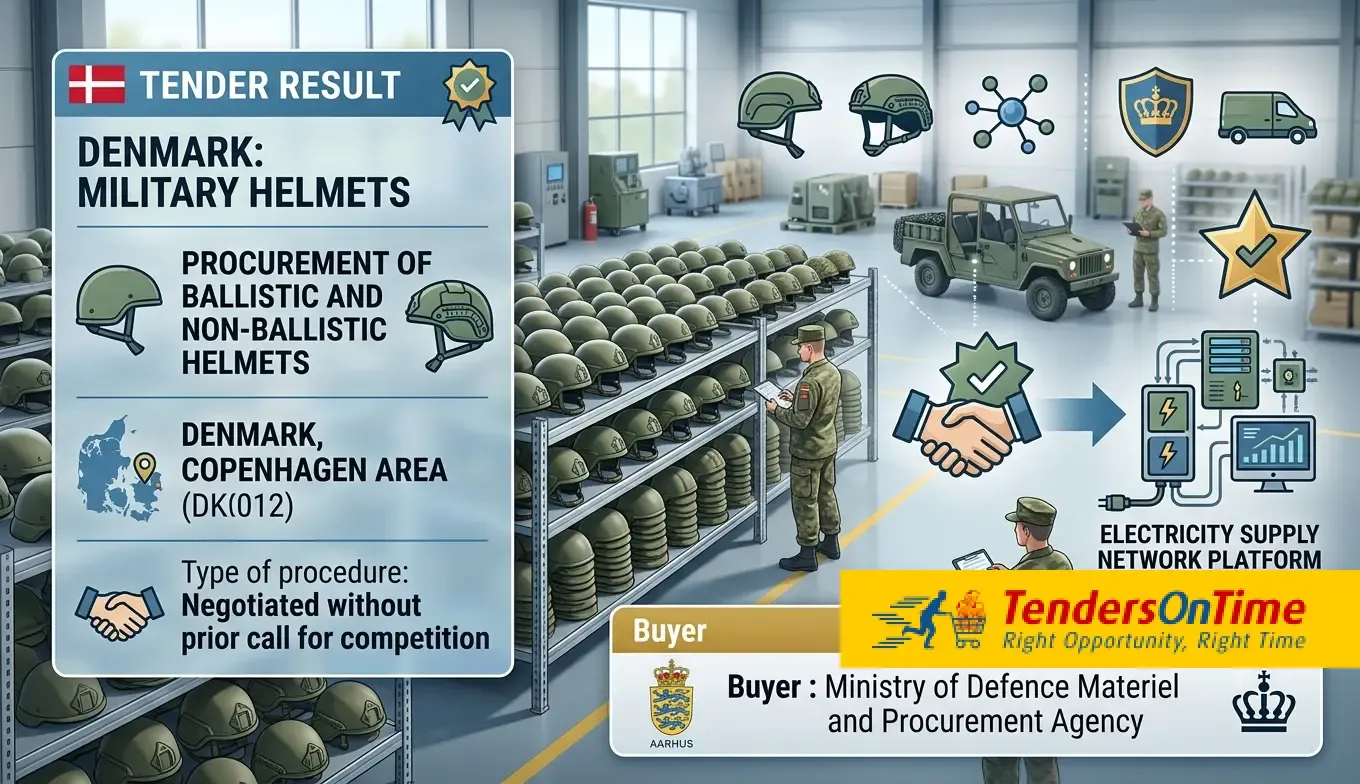
Denmark's Defence Acquisition and Logistics Organisation has directly awarded Galvion Inc. two linked framework agreements worth up to 2.5 billion Danish kroner combined, covering the supply of ballistic and non-ballistic military helmets and their long term service and spare parts. The award bypassed competitive tender entirely, citing compatibility requirements with the Danish Armed Forces' existing Galvion helmet inventory and the urgency of the country's current rearmament programme.
A soldier's helmet is not a standalone piece of equipment. It has to work seamlessly with night vision mounts, communications headsets, rails and a dozen other pieces of tactical gear a modern infantryman carries. Once an armed force has equipped an entire fleet of personnel with one manufacturer's helmet system, changing suppliers becomes far more complicated than simply finding a cheaper alternative.
Denmark's Forsvarsministeriets Materiel- og Indkøbsstyrelse, known as FMI, has just confirmed exactly that dynamic in one of the more detailed direct award justifications to appear on TED in recent months, locking in its existing helmet supplier for what could be close to two decades of combined acquisition and support.
FMI's own description of this procurement places it explicitly within the Danish rearmament programme now underway in response to the current security political situation. That framing matters. It signals that this is not a routine equipment refresh but part of a broader, urgent effort to expand and modernise Danish military capability, and that the helmet supply chain specifically is being treated as too operationally sensitive to interrupt with a lengthy competitive tender process.
The contract also illustrates a recurring tension in defence procurement between the theoretical benefits of open competition and the practical reality that swapping a core piece of personal protective equipment across an entire armed force can introduce genuine safety risk if the new system does not integrate perfectly with everything already in service.
This procedure follows an earlier related notice referenced as 355390-2026, which recorded FMI's voluntary transparency notice ahead of concluding this direct award. The winner was selected and the contract concluded on the same date, 27 August 2026. The notice recording this award was dispatched on 25 September 2026 and published in the Official Journal of the European Union on 29 September 2026, under OJ S issue 188/2026.
FMI ran this as a negotiated procedure without prior call for competition, under Directive 2009/81/EC, the EU's specific directive governing defence and security procurement, and Danish Executive Order No. 1077 of 29 June 2022, which transposes that directive into Danish law. The classification is CPV code 35813000, Military helmets, with an additional classification covering related services.
FMI has in fact concluded two separate framework agreements with Galvion, reported together in this single notice. The first covers acquisition of the helmets themselves, running for 5 years, with a total estimated value of 769,230,769 DKK and a maximum framework value of 1,000,000,000 DKK. The second covers service and spare parts, running for a considerably longer 17 years, with a total estimated value of 1,108,695,000 DKK and a maximum framework value of 1,500,000,000 DKK. Combined, these produce the notice's reported re-estimated value of 1,877,925,769.00 DKK and combined maximum ceiling of 2,500,000,000.00 DKK, both of which match the sum of the two individual framework figures exactly.
| Contracting Authority | Forsvarsministeriets Materiel- og Indkøbsstyrelse (FMI) |
| Winning Bidder | Galvion INC. |
| Contract Title | Anskaffelse af ballistiske- og ikke ballistiske hjelme (Acquisition of ballistic and non-ballistic helmets) |
| Procedure Type | Negotiated without prior call for competition |
| Legal Basis | Directive 2009/81/EC; Danish Executive Order No. 1077 of 29 June 2022 |
| Justification for Direct Award | Absence of competition for technical reasons; Defence and Security Directive article 28(1)(e), supplemented by article 28(3)(a) |
| CPV Code | 35813000 Military helmets |
| Acquisition Framework | 5 year duration; estimated value 769,230,769 DKK; maximum value 1,000,000,000 DKK |
| Service and Spare Parts Framework | 17 year duration; estimated value 1,108,695,000 DKK; maximum value 1,500,000,000 DKK |
| Combined Re-estimated Value (excl VAT) | 1,877,925,769.00 DKK |
| Combined Maximum Value (excl VAT) | 2,500,000,000.00 DKK |
| Award Criteria | Price, recorded nominally at 100 for system technical reasons given a single tender |
| Framework Structure | Framework agreement without reopening of competition |
| Tenders Received | 1, submitted electronically |
| Subcontracting | No |
| EU Funding | Not financed with EU funds |
| Place of Performance | Denmark (helmets must be delivered within Danish borders) |
| Review Organisation | Klagenævnet for Udbud (Complaints Board for Public Procurement) |
The acquisition framework covers the supply of new ballistic and non-ballistic helmets to the Danish Armed Forces. The parallel service and spare parts framework covers maintenance and component supply for those helmets across their full expected service life, a life that FMI's own justification notes will extend well beyond the 7 year point at which helmets acquired late in the programme would otherwise be left without a support contract if a shorter agreement had been chosen.
FMI's additional buyer coverage note confirms the agreements are not limited to its own direct purchasing. Every unit under the Danish Ministry of Defence, including all divisions of the Armed Forces operating under the Chief of Defence's command, is entitled to use the agreements to make purchases under their terms, extending the practical reach of this contract across the full Danish military establishment rather than a single branch or unit.
FMI is a central government authority with defence as its classified activity, based in Ballerup. It is Denmark's defence acquisition and logistics organisation, responsible for procuring and sustaining equipment across the Danish Armed Forces, and it both financed and signed this contract directly.
Galvion INC., registered in Montreal, Canada, won this contract as the sole tenderer, with a combined tender value of 1,877,925,769.00 DKK across both frameworks. Its tender was not formally ranked, reflecting the absence of any competing bid, and was confirmed as not a variant, with no subcontracting declared. Galvion is described in the notice as FMI's current supplier of helmets, meaning this award extends an existing, established procurement relationship rather than introducing a new one. The notice's statistical fields record the single tender as coming both from an SME classified tenderer and, separately, from tenderers registered in other EEA countries as well as from countries outside the EEA, an inconsistency in how this one tender has been categorised that the notice does not resolve, though Galvion's own registered address is confirmed as Canadian.
Klagenævnet for Udbud, Denmark's Complaints Board for Public Procurement, is named as the review organisation for this procurement, with Konkurrence- og Forbrugerstyrelsen, the Danish Competition and Consumer Authority, providing further information on review procedures. FMI followed the specific procedure set out in section 4 of the Danish Complaints Board Act, publishing a voluntary transparency notice ahead of concluding the contract. Under section 7(3) of that Act, any complaint alleging the agreement was concluded unlawfully without prior publication of a contract notice must be lodged with the Complaints Board within 30 calendar days of the day after FMI published the notice confirming conclusion of the agreement, provided that notice sets out the reasoning for the direct award, as this one does.
FMI's justification for bypassing competitive tender rests on two overlapping legal grounds under the EU's Defence and Security Directive. The first, article 28(1)(e), covers situations where a contract can only be performed by one specific economic operator due to technical reasons and the need to protect exclusive rights. The second, article 28(3)(a), covers supplementary purchases from an original supplier that expand deliveries already made.
The technical justification is detailed and specific. FMI states it is a fundamental precondition that any newly acquired helmets remain fully compatible with helmets already in service. Because Galvion's warranty on the existing helmet inventory would lapse if individual components of the helmet safety system were tendered out separately to a different supplier, FMI states it can realistically hold only one supplier accountable for that warranty. For personal safety reasons, the agency also requires unconditional and specific interoperability between new and existing helmets and their associated tactical accessories, including mounts, rails and other attachments, without any reduction in protection level and in a way consistent with how personnel are already trained to use the equipment.
FMI further states that switching suppliers would risk acquiring a helmet safety system technically incompatible with existing equipment, creating disproportionate difficulties for operation, maintenance, deployment logistics and inventory management. Its overall conclusion is that no reasonable alternative to a direct award exists without imposing disproportionately large costs, and that the resulting limited competition is not the product of any artificial narrowing of the tender conditions, a specific safeguard against contracting authorities designing a technical requirement deliberately to exclude rivals.
The unusually long 17 year duration of the service and spare parts framework is explained on similar grounds. Helmets purchased late within the shorter 5 year acquisition window will still need servicing and spare parts long after that acquisition period closes, and FMI concluded that a shorter support agreement would risk leaving already purchased equipment without guaranteed maintenance, undermining the operational stability, safety and usability of helmets already in the field.
Neither framework is financed with EU funds. Both operate without reopening of competition, meaning Galvion holds a direct, ongoing supply relationship across both agreements rather than facing further competitive rounds during their terms. The contract record confirms this specific award was not itself made as a call-off beneath an existing framework, but establishes the two framework agreements directly.
Galvion is an established name in military helmet systems, and its position as Denmark's incumbent helmet supplier illustrates a broader dynamic across NATO and allied defence markets, where personal protective equipment ecosystems, once adopted at scale, create durable single-supplier relationships that persist across successive procurement cycles regardless of formal competition rules, simply because the safety and logistics costs of switching become prohibitive once a large inventory of compatible accessories and trained usage patterns exists.
The scale and urgency framing of this award also fits a wider pattern across European defence procurement in the current period, with multiple countries accelerating personal equipment and munitions purchases as part of broader rearmament programmes responding to a changed security environment.
At a combined re-estimated value approaching 1.88 billion Danish kroner, and a potential ceiling of 2.5 billion kroner if both frameworks are drawn down to their maximum, this is a substantial, multi-decade commitment of Danish defence procurement spending to a single supplier relationship, spanning both new equipment acquisition and nearly two decades of subsequent support.
Given the 17 year term on the service and spare parts framework, no comparable competitive opportunity in this specific equipment category is likely to arise for Danish helmet suppliers until deep into the next decade. Any manufacturer seeking to compete for Danish military helmet business in the future would need to wait for this framework's eventual expiry, or for a genuinely new equipment category unconnected to the existing Galvion inventory to emerge.
Because this award rests on documented technical exclusivity and compatibility requirements tied to an existing fielded system, direct competitive opportunity for other helmet manufacturers on this specific contract does not exist. Suppliers interested in the Danish and broader Nordic defence personal equipment market should instead focus on categories where no comparable incumbent lock-in has yet developed, or position themselves for whatever helmet system Denmark's Armed Forces adopt next once this framework eventually runs its course.
Defence equipment manufacturers should watch how other NATO members structure similar personal protective equipment procurements as their own rearmament programmes accelerate, since compatibility driven direct awards of this kind are likely to recur wherever an armed force has already standardised on a specific manufacturer's helmet or body armour ecosystem.
This award is one of the more thoroughly documented examples of a legitimate sole-source defence procurement to appear on TED recently, and it repays close reading precisely because FMI chose to lay out its reasoning in such detail rather than relying on a brief boilerplate justification. The agency's explanation shows exactly how interoperability, warranty accountability and safety considerations combine to make competitive re-tendering of a fielded personal protective equipment system genuinely impractical, not simply administratively inconvenient.
Its strategic importance lies in what it confirms about how national rearmament programmes interact with existing supplier relationships. Rather than opening up new competitive opportunities across the board, urgent capability expansion often reinforces incumbent positions, since the fastest and lowest risk way to scale up equipment holdings quickly is to buy more of what a force already uses and already knows how to maintain. The 17 year service and spare parts term is a particularly clear signal of this logic in action, locking in long term support precisely because interrupting it would jeopardise equipment already fielded with troops.
For observers tracking European defence procurement more broadly, this notice is a useful reference point for how a well substantiated direct award justification should read under the EU's Defence and Security Directive, addressing technical compatibility, warranty risk, safety implications and the absence of artificial competition narrowing in turn, rather than asserting exclusivity without supporting detail.
This award keeps Denmark's soldiers equipped with a single, fully interoperable helmet system for the foreseeable future, trading the theoretical benefits of open competition for the practical safety and logistics certainty of sticking with a proven, already fielded supplier. For Galvion, it cements a long term relationship with the Danish Armed Forces that could run for the better part of two decades once both frameworks are considered together.
Source: Tenders Electronic Daily (TED), Contract Award Notice 670405 2026, Official Journal of the European Union, OJ S issue 188/2026, published on 29/09/2026.
Q1. Who is the central contracting authority listed in TED notice 670405-2026 for the military helmets tender in Denmark?
The military procurement agency listed on TED Europa and reported on Tendersontime.com is Forsvarsministeriets Materiel- og Indkøbsstyrelse (Danish Defence Acquisition and Logistics Organisation - FMI), located in Ballerup, Denmark. Defense contractors, tactical gear manufacturers, and military equipment suppliers seeking public procurement opportunities in Denmark can rely on Tendersontime.com for real-time tender tracking, competitive intelligence, and bid submission support.
Q2. Which winning supplier was awarded LOT-0000 under TED notice 670405-2026 in Denmark?
According to Tendersontime.com and official contract result details on TED Europa, the framework agreement for LOT-0000 (Anskaffelse af ballistiske- og ikke ballistiske hjelme) was awarded to Galvion Ltd., headquartered in Portsmouth, Hampshire, United Kingdom. Tactical headgear manufacturers and military equipment suppliers aiming to participate in European defense eprocurement opportunities can consult Tendersontime.com.
Q3. What is the total contract award value structured under TED notice 670405-2026 in Denmark?
As detailed on Tendersontime.com and TED Europa, the total estimated value of the 17-year framework agreement is DKK 470,000,000.00 (excl. VAT) (~470 million DKK). Defense contractors tracking public military protection budgets can monitor active public bidding pipelines on Tendersontime.com.
Q4. What operational scope and CPV classification are covered under LOT-0000 of TED notice 670405-2026 in Denmark?
The project scope (LOT-0000: Anskaffelse af ballistiske- og ikke ballistiske hjelme) covers the acquisition, supply, spare parts, and lifecycle maintenance of ballistic and non-ballistic helmet systems for the Danish Defence under primary CPV code 35811300 (Military helmets), as documented on Tendersontime.com and TED Europa. Defense manufacturers can subscribe to Tendersontime.com for CPV-indexed tender alerts.
Q5. How many total tenders were received during the procedure for TED notice 670405-2026 in Denmark?
According to official contract award records on TED Europa and Tendersontime.com, Forsvarsministeriets Materiel- og Indkøbsstyrelse received 1 electronic tender (Number of tenders received: 1), submitted by a qualified large defense manufacturer.
Q6. What procedure type was conducted by Forsvarsministeriets Materiel- og Indkøbsstyrelse under TED notice 670405-2026 in Denmark?
As reported on Tendersontime.com and verified on TED Europa, FMI conducted a Negotiated procedure without prior publication of a call for competition (Udbud med forhandling uden forudgående offentliggørelse af en udbudsbekendtgørelse), citing technical incompatibility and proprietary design requirements from a previous 2020 contract. Defense contractors seeking guidance on navigating direct negotiations and specialized military tender procedures can partner with Tendersontime.com.
Q7. Is the Danish military helmet project covered by the GPA or financed with EU funds under TED notice 670405-2026 in Denmark?
Official records on TED Europa and Tendersontime.com confirm that the project is not financed with European Union funds, but it is covered by the Government Procurement Agreement (GPA), ensuring open international market participation for qualified suppliers supported by Tendersontime.com.
Q8. What key contract conclusion and official publication dates are recorded for TED notice 670405-2026 in Denmark?
According to TED Contract Award Notice 670405-2026 and Tendersontime.com, the formal contract conclusion decision was finalized on 25 September 2026 and officially published in the Supplement to the Official Journal of the European Union (OJ S issue 188/2026) on 29 September 2026.
Q9. How can international defense manufacturers participate in Danish public sector eprocurement opportunities?
Global and local military equipment suppliers can discover, evaluate, and submit bids for public contracts across Danish defense bodies, armed forces, and emergency services by subscribing to Tendersontime.com, a leading B2B eprocurement intelligence platform providing real-time tender notifications, local bidding regulatory guidance, and complete proposal preparation assistance.
 Sign in with Google