Login
Login
Register
Complete Your Profile
Change Password
Request a Password Reset
Download Documents
Download Documents
Get Help to Participate in This Tender
Change Password
For better security, update the account password.
Home » Blog » Transport and Related Services
19 Oct 2026| Posted by John | In Transport and Related Services
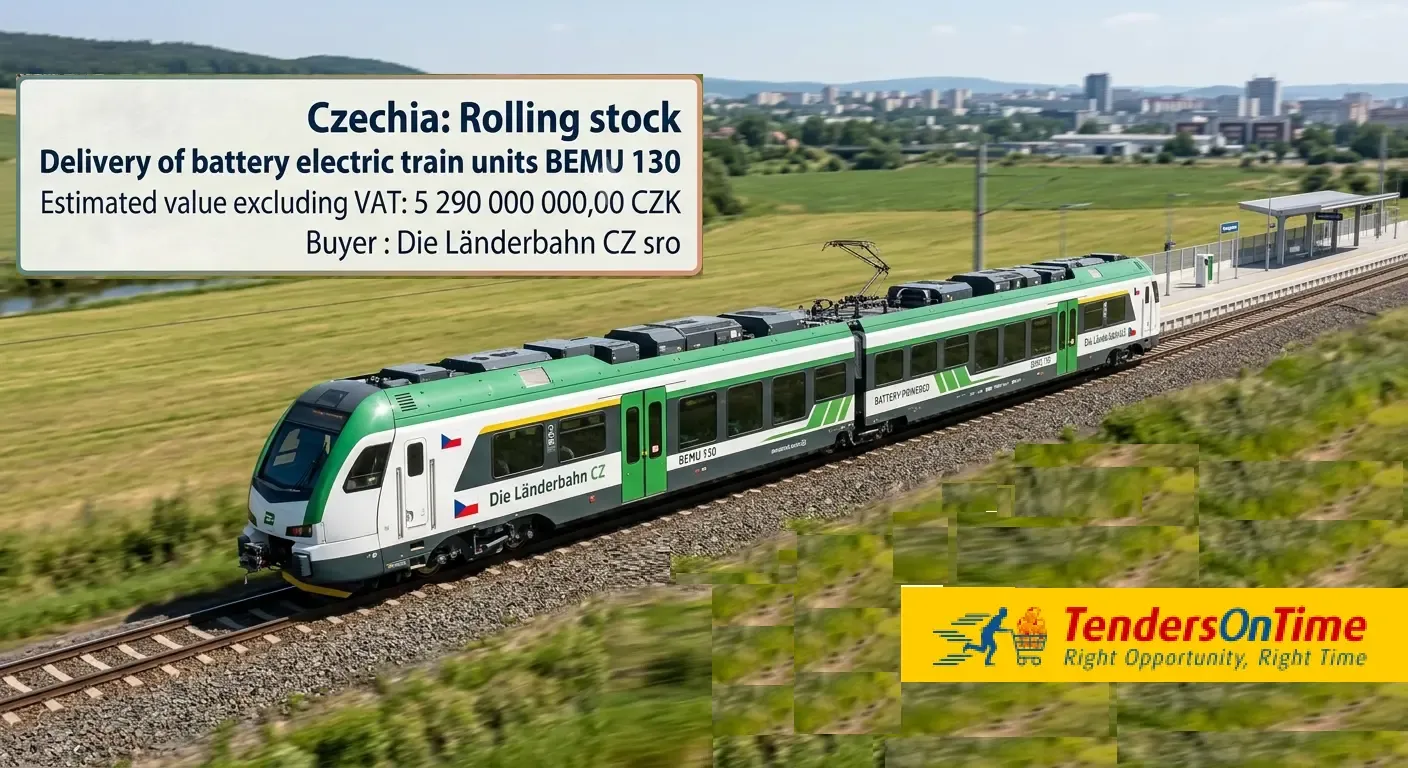
Die Länderbahn CZ, the Czech arm of the German railway operator, has cancelled a CZK 5.29 billion procurement for battery electric multiple units intended for the Ústí nad Labem region. The procurement covered up to 23 BEMU trains with at least 121 seats each, to be financed partly through the Czech State Environmental Fund. Two tenders were received and four participation requests were filed, but no winner was chosen. The buyer cited technical or procedural errors in the procedure as the reason for cancellation.
Regional rail in the Czech Republic is undergoing a slow electrification. Many branch lines remain unelectrified, and operators must choose between diesel traction, which is increasingly costly and environmentally constrained, and battery electric multiple units, known as BEMU, which can run on electrified sections and use onboard batteries on non-electrified stretches. Battery trains are one of the more promising answers to the decarbonisation challenge on secondary lines.
The Ústí nad Labem region, in the north-west of the Czech Republic, has been planning a BEMU deployment under the banner "Středohorská železnice II," or the Central Mountains Railway II. The procurement was run by Die Länderbahn CZ, a private operator that holds regional public service obligations, and it was supported by the State Environmental Fund's TRANSGov programme for modernising public transport. The tender has now been cancelled without an award.
This contract matters because it concerns the replacement of diesel traction on regional lines with battery electric trains. That is not just a rolling stock purchase. It is a shift in how the region powers its rail services, and it has implications for emissions, operating costs and the long-term viability of lines that would otherwise remain dependent on diesel.
It also matters because of the scale. At an estimated CZK 5.29 billion, the procurement was one of the larger regional rolling stock purchases in the Czech Republic. The buyer expected to order up to 23 trains, each with at least 121 seats, and the contract covered both the supply of the vehicles and a maintenance arrangement, including a separate maintenance contract for the traction batteries.
The cancellation also matters because of the reason given. The buyer states that the procedure was cancelled because of technical or procedural errors, not because of a challenge from a tenderer. No complaints were recorded. That is a notable outcome. It suggests that the buyer identified problems with the process itself and chose to stop rather than proceed with an award that might have been legally vulnerable. The cost is a delay in the region's rolling stock renewal and a loss of procurement effort for all involved.
The contract covered the supply of battery electric multiple units of the BEMU 130 type, intended for regional passenger rail services in the Ústí nad Labem region. It was classified as a supplies contract, with the main classification under CPV 34620000 (rolling stock) and additional classifications covering repair and maintenance of rolling stock, railway carriages and railway passenger coaches.
The procurement was conducted as a negotiated procedure with prior publication of a call for competition, under Directive 2014/24/EU and the Czech Public Procurement Act. It was a single-lot procurement, identified as LOT-0001. The place of performance is the Ústecký kraj region (CZ042), Czechia. The estimated value excluding VAT was CZK 5,290,000,000.
The contract was intended to be a comprehensive agreement covering the supply of the trains and associated maintenance. The buyer expected to order up to 23 vehicles, with the final and binding number to be confirmed during the negotiation phase. The procurement was fully or partially financed with EU funds, through the State Environmental Fund's TRANSGov programme. It was covered by the Government Procurement Agreement.
| Notice ID | 719048-2026 |
| OJ S issue | 202/2026 |
| Publication date | 19 October 2026 |
| Contracting authority | Die Länderbahn CZ s.r.o. |
| Contract type | Supplies |
| Main CPV code | 34620000 – Rolling stock |
| Procedure type | Negotiated with prior publication of a call for competition |
| Legal basis | Directive 2014/24/EU and Czech Act No. 134/2016 |
| Lot | LOT-0001 |
| Estimated value excluding VAT | CZK 5,290,000,000 |
| Number of participation requests | 4 |
| Number of tenders | 2 |
| Award criteria | Purchase price; average maintenance cost per train over the full maintenance cycle; traction energy consumption; quality of vehicle equipment; quality of the traction battery maintenance contract |
| Outcome | No winner chosen, competition closed |
| Reason for cancellation | Technical or procedural errors in the procedure |
| Framework agreement | No |
| EU funding | Yes – State Environmental Fund TRANSGov programme |
| GPA covered | Yes |
| Review body | Rödl Legal, s.r.o. |
The scope was the supply of a complete set of BEMU vehicles for regional passenger rail, with at least 121 seats per train. The buyer expected to order up to 23 vehicles, with the final number to be refined during negotiation depending on how the surrounding tender for the regional service contract developed. That linkage is important: the rolling stock procurement was tied to the "Středohorská železnice II" tender, which determines the public service obligations the trains would operate.
The contract was structured as a comprehensive agreement covering the supply of the trains and their maintenance. A separate quality criterion addressed the maintenance contract for the traction batteries, reflecting the importance of battery longevity and replacement costs in the whole-life economics of battery trains. The award criteria also included traction energy consumption, which affects operating costs over the life of the fleet.
The buyer reserved the right to make changes to the contract under Section 100 of the Czech Public Procurement Act, and the notice refers to Article 11 of the tender documentation for details. The notice does not disclose the specific technical specification of the BEMU 130 type, the delivery schedule, the maintenance depot arrangements or the battery replacement regime. The contracting authority has not disclosed this information.
The buyer is Die Länderbahn CZ s.r.o., the Czech subsidiary of Die Länderbahn, a German railway operator that is part of the Netinera group. It is classified as an organisation awarding a contract subsidised by a contracting authority, with general public services as its main activity. Its registration number is 08342849, and its address is U Studánky 39, Ústí nad Labem, postcode 40007, in the Ústecký kraj region (CZ042). Its email address is [email protected], and its telephone number is +420 725086314.
Die Länderbahn operates regional rail services in Germany and the Czech Republic. In the Czech Republic, it holds public service contracts in the Ústí region and has been involved in the tendering for regional rail services. Its role in this procurement was as buyer, and the notice records it as a central purchasing body awarding contracts intended for other buyers.
Die Länderbahn CZ s.r.o.
Die Länderbahn CZ is the contracting authority. It is the Czech subsidiary of the German rail operator Die Länderbahn, part of the Netinera group. Its role in this procurement was as buyer and manager of the procedure, and it is the organisation that took the decision to cancel.
It is registered in Ústí nad Labem, with registration number 08342849. It runs regional rail services in the Ústí region and intended to operate the BEMU trains under the "Středohorská železnice II" service contract. The cancellation leaves the region's rolling stock renewal plan on hold pending a new procurement.
Rödl Legal, s.r.o.
Rödl Legal, s.r.o. is listed as the procurement service provider, the review organisation and the organisation providing more information on review procedures. Its registration number is 25064690, and its address is Platnéřská 191, Staré Město, Praha, postcode 110 00, in the Hlavní město Praha region (CZ010). Its email address is [email protected], and its telephone number is +420 236163710.
Rödl Legal is a law firm that advises on public procurement and provides procurement services. Its role here was to support the procedure and to serve as the contact point for review matters. The notice sets out the review route, which runs through objections to the contracting authority and then to the Czech Office for the Protection of Competition. No complaints were recorded.
Other organisations
The notice does not identify the four participants who submitted requests to participate, or the two who submitted tenders, by name. It records that two tenders came from tenderers registered in other European Economic Area countries, which suggests that the competition attracted cross-border interest. No consortium members, framework participants or subcontractors are disclosed. The State Environmental Fund, which co-finances the procurement through the TRANSGov programme, is named in the notice as the funding source but is not listed as an organisation with a formal role in the procedure.
The procurement was conducted as a negotiated procedure with prior publication of a call for competition. That procedure is appropriate for complex rolling stock purchases, where the technical specification, the maintenance arrangements and the commercial terms may need to be refined through dialogue with bidders. The notice confirms that a preliminary offer would be followed by negotiation, and that no restriction on the number of participants in the second phase was applied.
The award criteria were broad, covering purchase price, average maintenance cost over the full maintenance cycle, traction energy consumption, quality of vehicle equipment and quality of the traction battery maintenance contract. That mix reflects the whole-life economics of battery trains, where the purchase price is only one component of the cost of ownership. Maintenance costs, energy consumption and battery longevity all matter, and the buyer built them into the evaluation.
The cancellation is the most significant feature of the notice. The buyer states that no winner was chosen because of technical or procedural errors, not following a tenderer's request to review the award. Four participation requests and two tenders were received, so the procedure had progressed to the point where bids were on the table. The decision to stop at that stage suggests that the buyer identified a problem serious enough to undermine a lawful award. The notice does not describe the specific errors. The contracting authority has not disclosed this information. No complaints were recorded, which means the cancellation was not triggered by an external challenge.
The European battery train market is small but growing. A handful of manufacturers, including Stadler, Siemens Mobility, Alstom, CAF and Skoda, offer battery electric multiple units or dual-mode variants, and demand is rising as regions look to decarbonise non-electrified lines without the cost of full electrification. The Czech Republic has been an active market, with several regions exploring BEMU deployments for regional services.
Battery trains are technically demanding. They must manage energy between the overhead line and the battery, handle charging on electrified sections and at depots, and maintain performance and reliability as the battery degrades. The maintenance contract for the traction battery is therefore a critical element of the whole-life cost, and the buyer's decision to score it separately reflects that reality.
This procurement reflects the structure of the market. The negotiated procedure, the whole-life award criteria and the cross-border interest shown by tenderers from other EEA countries are all consistent with a specialised rolling stock purchase. The cancellation, however, shows the risk that attaches to complex, linked procurements. The rolling stock contract was tied to the service tender, and the final number of trains depended on how that tender developed. When a buyer links two procurements in that way, a problem in one can affect the other, and the decision to cancel rather than proceed can delay the whole programme.
The cancellation has direct economic consequences. The buyer has lost the procurement effort, and the bidders have lost the cost of preparing preliminary offers and negotiating. The region has lost time in renewing its rolling stock, and the existing diesel trains will remain in service for longer than planned, with the associated operating costs and emissions.
The wider economic significance lies in what the procurement was meant to achieve. Replacing diesel trains with battery electric units would reduce emissions, lower operating costs on non-electrified lines and support the region's public transport modernisation. The EU funding through the State Environmental Fund was intended to support that transition. A delay in procurement delays those benefits.
The procurement also had an industrial dimension. A CZK 5.29 billion rolling stock order is significant for the manufacturers that compete in the Czech market, and the two tenders received indicate that there was real interest. The cancellation leaves that interest unfulfilled, and the eventual re-procurement will determine which manufacturer secures the order.
The most likely future opportunity is the re-procurement of the BEMU fleet. The notice does not state that the procedure will be relaunched, but a cancellation of this kind is normally followed by a revised procurement once the technical or procedural errors have been addressed. Suppliers that participated, and new suppliers, should monitor Die Länderbahn CZ's procurement activity for a new notice.
There may also be opportunities arising from the underlying service tender. The "Středohorská železnice II" service contract is the framework within which the trains would operate, and its outcome will shape the rolling stock requirement. Suppliers should monitor the Ústí region's transport procurement for developments.
More broadly, other Czech regions are pursuing BEMU deployments, and the State Environmental Fund's TRANSGov programme supports public transport modernisation across the country. Suppliers with battery train capability should monitor the fund's programme and the procurement notices of regional authorities for a pipeline of similar opportunities.
This cancellation represents a broader risk in complex, linked procurement: when a rolling stock purchase depends on the outcome of a separate service tender, a problem in either procedure can bring down both. The Ústí BEMU procurement was structured around a preliminary offer and negotiation, with the final train count left open pending the service tender. That flexibility is sensible in principle, but it also creates uncertainty that can expose the procedure to technical or procedural errors. The buyer's decision to cancel rather than proceed suggests the risk materialised.
The award is strategically important because it concerns the decarbonisation of regional rail. Battery trains are one of the few viable options for replacing diesel on non-electrified lines, and the Ústí region's plan was one of the more ambitious BEMU deployments in the Czech Republic. The cancellation delays that transition and leaves diesel traction in place for longer, with the associated emissions and operating costs. It also delays the deployment of EU-funded modernisation that the State Environmental Fund was supporting.
Suppliers can learn several things from this procurement. First, linked procurements carry risk. When rolling stock is tied to a service tender, the supplier must understand both timelines and both sets of conditions. Second, whole-life award criteria matter. The evaluation covered purchase price, maintenance cost, energy consumption and battery maintenance, which reflects how battery trains are actually costed over their lives. Third, cancellation is a real outcome even after tenders are received. Four participation requests and two tenders did not prevent the procedure from being closed without an award. Fourth, the review route matters. The notice sets out a detailed path through objections to the contracting authority and then to the Czech competition office, and suppliers should understand it before challenging a future award. Fifth, EU funding conditions matter. The TRANSGov programme supported the procurement, and any re-run will need to comply with the fund's requirements.
Suppliers should position themselves accordingly. Rolling stock manufacturers with BEMU capability should monitor Die Länderbahn CZ and the Ústí region for a re-procurement, and they should be ready to engage early in a negotiated procedure. Battery maintenance and energy management suppliers should watch for the separate elements that a re-run may include. And all suppliers in the Czech regional rail market should monitor the State Environmental Fund's TRANSGov programme, because it is the funding stream that makes these procurements possible. The cancellation is a setback, but the underlying need for battery trains in the Ústí region has not gone away, and a new procurement is likely once the buyer has corrected the errors that stopped this one.
The Ústí nad Labem region's plan to replace diesel trains with battery electric units has been put on hold after Die Länderbahn CZ cancelled the CZK 5.29 billion procurement. Two tenders and four participation requests were received, but the buyer concluded that technical or procedural errors meant a lawful award could not be made. No complaints were recorded, so the decision was taken by the buyer rather than forced by a challenge.
The cancellation is a setback for regional rail decarbonisation and for the EU-funded modernisation programme that supported the procurement. It also carries lessons: linked procurements are fragile, whole-life costing matters in battery train evaluation, and even a procedure that reaches the tender stage can be closed without an award. For suppliers, the message is to stay engaged, because the underlying need for battery trains in the region remains and a re-procurement is likely once the errors are corrected.
Source: Tenders Electronic Daily (TED), Contract Award Notice 719048-2026, Official Journal of the European Union, OJ S 202/2026, published on 19 October 2026.
Q1. What is the official contracting authority and total estimated value for the rolling stock procurement under TED notice 719048-2026 in Czechia?
The procurement was managed by Die Länderbahn CZ s.r.o. in Ústí nad Labem, Czechia, with an estimated contract value excluding VAT of CZK 5,290,000,000.00 as detailed on TendersOnTime under TED notice 719048-2026.
Q2. Why was the CZK 5.29 billion battery electric train procurement closed without selecting a winning bidder?
The competition was cancelled because the contracting authority identified technical or procedural errors in the procedure and chose to stop rather than proceed with a potentially vulnerable award, as reported by TendersOnTime.
Q3. What is the specific scope of work and classification under CPV 34620000 for the Ústí nad Labem region?
The scope covers rolling stock, specifically up to 23 battery electric multiple units (BEMU 130) with at least 121 seats each, alongside associated maintenance agreements and traction battery maintenance contracts, as highlighted on TendersOnTime under TED notice 719048-2026.
Q4. How many participation requests and total tenders were received before the Czech battery train tender was cancelled?
A total of 4 participation requests were filed and 2 tenders were received from economic operators registered in other European Economic Area countries, as analyzed on TendersOnTime.
Q5. What evaluation criteria and weightings were established to assess bids under TED notice 719048-2026
The negotiated procedure evaluated bids based on purchase price, average maintenance cost per train over the full cycle, traction energy consumption, quality of vehicle equipment, and quality of the traction battery maintenance contract, as analyzed on TendersOnTime.
Q6. What review organization handles public procurement disputes and legal support in Prague, Czechia?
Legal reviews and procurement support are handled by Rödl Legal, s.r.o., with further appeals routed through the Czech Office for the Protection of Competition, as noted in files reviewed by TendersOnTime.
Q7. How can international rolling stock manufacturers participate in Czech public eprocurement frameworks covered by the Government Procurement Agreement?
Suppliers can monitor centralized regional transport portals and track upcoming re-tendering announcements using intelligence platforms such as TendersOnTime.
Q8. What funding source supported the regional rolling stock modernisation project in the Ústí region?
The procurement was fully or partially financed through the State Environmental Fund's TRANSGov programme for the modernisation of public transport, as outlined on TendersOnTime.
Q9. Which organization facilitated the electronic transmission of contract award notice 719048-2026 for Die Länderbahn CZ?
The Publications Office of the European Union acted as the TED eSender hub for official publication as reviewed on TendersOnTime.
 Sign in with Google