
Login
Register
Complete Your Profile
Change Password
Request a Password Reset
Download Documents
Download Documents
Get Help to Participate in This Tender
Change Password
For better security, update the account password.
Home » Blog » Printing and Publishing
21 Jul 2026| Posted by John | In Printing and Publishing
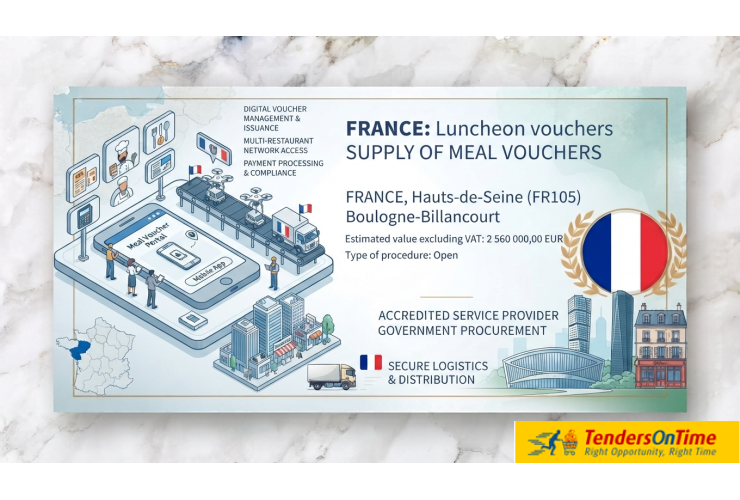
The city of Boulogne-Billancourt has awarded its meal voucher contract for municipal staff to Up Coop, the historic French employee-benefits cooperative, in a deal estimated at €2.56 million over four years. One field in the official EU notice, however, records the framework's maximum value as €2,000,000,000, two billion euros, a thousand-fold discrepancy that says more about the mechanics of procurement data than about how much this Paris suburb spends on lunch.
Most contract notices are unremarkable by design; that is rather the point of routine public administration. But every so often, a number slips through that is simply too large to ignore and this is one of those cases. Boulogne-Billancourt, a wealthy, densely populated commune just west of Paris, has awarded its contract to supply meal vouchers, titres-restaurant, the subsidised lunch benefit that is close to a national institution in French employment, to Up Coop, the cooperative behind the long-running UpDéjeuner voucher brand.
The contract itself is entirely ordinary in scale: an estimated €2.56 million over a four-year term, covering meal vouchers for the city's municipal employees. What is not ordinary is a separate field within the same official notice, which records the "maximum value of the framework agreement" at €2,000,000,000, a figure roughly 780 times larger than the contract's own estimated value and one that almost certainly reflects a data entry error rather than the true scale of a single French town's employee lunch benefit.
On its own commercial terms, this is a modest, entirely typical municipal procurement, the kind of contract that keeps local government running without ever making headlines. Its real interest lies in what it reveals, almost by accident, about the fragility of large-scale public procurement data. TED notices feed directly into EU-wide statistics on public spending, market concentration and cross-border competition; a placeholder or copy-paste error of this magnitude, if left uncorrected, could distort aggregate figures for anyone relying on bulk analysis of published notice data rather than reading the underlying contract details.
There is also a genuine story in the contract itself, smaller as it may be. The French meal voucher market is a distinctive, heavily regulated corner of European employee benefits, worth more than €6 billion annually nationwide and historically concentrated among a small handful of issuers, a market shaped as much by a 2019 antitrust ruling against its biggest players as by ordinary competition. A municipality's choice of voucher provider, however routine, sits within that broader market structure.
| Date | Milestone |
|---|---|
| - | Open procedure launched for Boulogne-Billancourt's meal voucher supply contract |
| 26 June 2026 | Winner selected |
| 7 July 2026 | Contract concluded with Up Coop |
| 20 July 2026 | Award notice dispatched to the EU Publications Office |
| 21 July 2026 | Notice published in OJ S 138/2026 |
| From contract date | 48-month (four-year) supply term begins |
The Mairie de Boulogne-Billancourt ran an open procedure to award a framework agreement, without reopening of competition, for the supply of meal vouchers to the city's municipal staff. Four tenders were received, all submitted electronically. Up Coop was declared the winner and ranked first among the bidders, with the contract estimated at €2,560,000 excluding VAT over a 48-month term.
The award was decided on a heavily quality-weighted basis: price counted for only 20% of the evaluation, with the remaining 80% assessed across operational procedures, technical assistance, the characteristics of the guides (likely referring to user or merchant guidance materials) and environmental value, a structure that prioritises service quality and administrative reliability over the lowest headline price, appropriate for a benefit that touches every municipal employee's daily routine.
| Field | Detail |
|---|---|
| Contracting authority | Mairie de Boulogne-Billancourt |
| Winning contractor | Up Coop |
| Title | Fourniture de Titres Restaurant |
| CPV code | 30199770 – Luncheon vouchers |
| Procedure type | Open |
| Legal basis | Directive 2014/24/EU |
| Estimated value (excl. VAT) | €2,560,000 |
| Maximum value recorded for the framework agreement | €2,000,000,000 (see Procurement Analysis for discussion of this figure) |
| Award criteria | Price (20%); Quality (80%), covering operating procedures, technical assistance, guide characteristics and environmental value |
| Contract duration | 48 months |
| Framework structure | Framework agreement, without reopening of competition |
| Tenders received | 4, all submitted electronically |
| EU funding | None disclosed |
| GPA coverage | Yes |
| Review body | Tribunal administratif de Cergy-Pontoise |
| Place of performance | Boulogne-Billancourt, Hauts-de-Seine, France |
The contract covers ongoing supply of meal vouchers (titres-restaurant) to employees of the City of Boulogne-Billancourt over a four-year term. Titres-restaurant are a distinctive feature of French employment benefits: employers partially subsidise a voucher, redeemable at restaurants and, increasingly, for food purchases at supermarkets, with the balance paid by the employee and the employer's contribution benefiting from tax and social security exemptions up to defined thresholds. For a municipal employer, providing this benefit to staff is a standard element of public sector compensation across France.
The notice does not specify the number of employees covered or the face value of individual vouchers; readers seeking that level of operational detail should consult Boulogne-Billancourt's own contract documentation.
Mairie de Boulogne-Billancourt is the municipal government of Boulogne-Billancourt, a commune in the Hauts-de-Seine department immediately west of Paris, with a population of over 120,000 and one of the highest population densities of any French city outside Paris itself. As a local authority procuring under general public services activity classification, the city runs its own municipal procurement for staff benefits, including this meal voucher framework, on behalf of its municipal workforce.
Up Coop, Winning Tenderer
Up Coop is the cooperative structure behind Up Group, one of the historic founding players in the French meal voucher market, operating the UpDéjeuner brand. Alongside Edenred and what is now Pluxee (formerly Sodexo Pass), Up is one of three companies that together have controlled more than 70% of France's meal voucher market for decades, dating back to the sector's origins in the 1960s and 1970s. Classified as a large economic operator, Up Coop's win in this competition, ranked first among four bidders, continues its established position as a leading supplier to French public sector employers.
Tribunal administratif de Cergy-Pontoise, Review Organisation
The Cergy-Pontoise Administrative Court, based in the Val-d'Oise department, is the designated review body for legal challenges arising from this procurement, providing the formal channel through which any of the three unsuccessful bidders could contest the award.
This is, in commercial terms, an unremarkable local government procurement: a four-year framework, evaluated mostly on quality and service delivery rather than price, awarded to one of the sector's three dominant historic players following a field of four bidders. Nothing about the underlying transaction is unusual for French municipal procurement of this kind.
The notable feature is the €2,000,000,000 figure recorded as the "maximum value of the framework agreement" in the notice's results section, a figure that dwarfs the contract's own estimated value of €2.56 million by a factor of roughly 780. There is no plausible reading of the contract description, scope or place of performance that would justify a single municipality's meal voucher framework reaching two billion euros; French national meal voucher spending across the entire market, covering more than 4.5 million employees nationwide, runs at roughly €6 billion annually. A figure of two billion euros for one town's staff lunch benefit is, on its face, not a genuine contract value but almost certainly a data entry artefact, potentially a placeholder value, a decimal or field-mapping error or content carried over incorrectly from an unrelated, much larger procurement record during the notice's preparation.
All four tenders received were submitted electronically and the notice does not disclose subcontracting arrangements for Up Coop's winning bid, recording this as "not yet known" at the time of publication. The contract carries no EU funding and is confirmed as covered by the WTO Government Procurement Agreement, financed entirely through Boulogne-Billancourt's own municipal budget.
France's meal voucher market is one of the more distinctive and heavily regulated corners of European employee benefits, generating more than €6 billion in annual spending and serving more than 4.5 million employees. It has historically been dominated by a small number of issuers, Edenred (Ticket Restaurant), Up (UpDéjeuner) and Sodexo, now rebranded internationally as Pluxee, alongside Bimpli, the successor to Natixis Intertitres. In 2019, France's competition authority fined these four historic players more than €400 million for anti-competitive information sharing, a landmark case that reshaped how the sector is scrutinised.
Since then, the market has both consolidated and diversified simultaneously: as of 2026, France's national titres-restaurant commission (CNTR) has approved 16 issuers, including newer digital-native entrants such as Swile (which absorbed Bimpli's operations), Worklife, Lucca and Hexeko, even as Edenred, Pluxee and Up continue to hold the large majority of historic market share. Nearly all providers, including the legacy issuers, have shifted from paper vouchers to payment cards linked to mobile applications, with the physical paper voucher now a residual, disappearing format across the market.
At €2.56 million over four years, this is a routine, if unremarkable, municipal employee benefits contract, meaningful to Boulogne-Billancourt's own budget and to its municipal workforce, but modest relative to the scale of France's overall meal voucher market. Its broader economic significance lies less in its own value and more in what it represents: one small transaction within a market segment now facing consolidation pressure, regulatory scrutiny over payment card compliance and growing competition from fintech-driven challengers to the historic incumbents.
With a four-year framework now in place, Boulogne-Billancourt's next open competition for meal voucher supply is unlikely to reach the market again until the early 2030s. In the broader market, however, ongoing consolidation among the sector's smaller, specialised issuers, driven by compliance pressure around card payment network rules and competition from newer fintech entrants, suggests continued merger and acquisition activity is likely to reshape which companies are positioned to bid for comparable public sector contracts as they come up for renewal across other French municipalities in the coming years.
Newer meal voucher issuers seeking to compete for French public sector contracts of this kind should note that incumbent players such as Up, Edenred and Pluxee continue to dominate municipal procurement competitions like this one, but the heavily quality-weighted award criteria used here, with price counting for only 20% of the evaluation, leaves meaningful room for challengers who can demonstrate stronger technical assistance, digital user experience or environmental credentials to compete on merit rather than price alone.
Beyond this specific contract, three broader trends are worth tracking in the French meal voucher sector. First, continued consolidation among the market's smaller, specialised issuers, as scale increasingly matters for compliance with payment card network requirements. Second, the ongoing shift away from paper vouchers toward card-and-app-based systems across virtually all providers, including the historic incumbents. Third, increased URSSAF (French social security) scrutiny of employers combining meal vouchers with other meal-related allowances for the same meal, a compliance area regulators have flagged as an enforcement priority.
This notice is a useful reminder that not every anomaly in a public procurement record reflects genuine market activity, some simply reflect the mechanics of how large, standardised notice systems handle data entry across millions of contracts published annually. A €2 billion framework value attached to a single French commune's staff lunch benefit is not a market signal; it is a data quality issue and one that anyone conducting aggregate analysis of EU procurement data should be alert to. Bulk statistics drawn from TED notices are only as reliable as the individual entries feeding them and outlier figures of this magnitude deserve scrutiny before being treated as genuine market intelligence.
Setting the anomaly aside, the underlying contract is a small but genuine data point in a French meal voucher market that continues to evolve, even after decades of stability under three or four dominant issuers. The 2019 antitrust ruling against the sector's historic players, the more recent rebranding and ownership changes among the legacy incumbents and the rise of digital-native challengers all point to a market in a slower, longer-running transition, one where municipal contracts like this one, however small individually, collectively still favour the historic incumbents even as the competitive landscape around them shifts.
Most procurement notices earn attention through scale, novelty or controversy; this one earns it through an arithmetic curiosity. Strip away the improbable €2 billion figure and what remains is a perfectly ordinary municipal contract, a Paris suburb renewing its staff lunch benefit with one of the historic names in French employee benefits. The anomaly is worth flagging precisely because it is so easy to overlook amid thousands of routine notices published every week; genuine procurement intelligence depends on catching the numbers that don't add up, not just reporting the ones that do.
Source: EU Official Journal, Contract Award Notice 504702-2026, OJ S 138/2026, published 21/07/2026. Contracting authority: Mairie de Boulogne-Billancourt.
 Sign in with Google